Showing posts with label Jonathan Becker. Show all posts

9.12.2018

JONATHAN BECKER: Elaine's Kitchen in Drugstore Culture's Inaugural Issue

Elaine at Elaine’s, 2002, with some regulars (L to R): 
Lewis Lapham, Frederick Seidel, Father Pete Colapietro, Mayor David Dinkins, George Plimpton, Terry McDonell, Chuck Pfeifer, Josh Gasparo, Nelson Aldrich, Bobby Zarem, David Black & A. E. Hotchner
Photograph © Jonathan Becker

John Paul Getty III, Linda Hutton, Averil P. Meyer
and Fred Hughes in Elaine’s kitchen, 1976
Photograph © Jonathan Becker

Brassaï’s 80th Birthday at Elaine’s, 9 September 1979
Photograph © Jonathan Becker

Elaine’s was a form of inheritance to me, and I didn’t squander it.  Both my mother and my father were part of an intellectual and theatrical New York culture - intelligencia, litterati, glitterati, whatever - that made the city glow in the Sixties and Seventies… 
 – Jonathan Becker

A special portfolio by Jonathan Becker of his brilliant photographs documenting the heyday of Elaine’s Restaurant in New York, illustrated with his personal reminiscences,  is published in the first ever glorious Inaugural Issue of DRUGSTORE CULTURE.

DRUGSTORE CULTURE's Publisher, Charles P. Finch

"Is it a book? Is it a magazine?...." asks British GQ's Charlie Burton. 
I don't know, but I do know it's about Culture and Politics • To be published 6 times a year • The first issue has Film, Art, and Soul and the aforementioned fabulous Portfolio by Jonathan Becker • A digital platform will be live shortly • To receive a copy of the Inaugural Issue, DM/instantmessage your address to @finchandpartners on #instagram for your free issue!

going live any day now in september • dm your address to
@finchandpartners on #instagram for your free issue


@finchandpartners #jonathanbecker
12.15.2012

2012 HOLIDAY BOOKS: A Few New Favorites I

 Saul Leiter
With Vince Aletti and Margit Erb, and others
Kehrer Verlag; First Edition (2012)
 
"Painter and Photographer Saul Leiter (b. 1923) exhibited alongside abstract expressionists like Willem de Kooning before beginning in the late 1940s to take photographs. Like Robert Frank or Helen Levitt, he found his motifs on the streets of New York, but at the same time was visibly interested in abstraction. Edward Steichen was one of the first to discover Leiter's photography, showing it in the 1950s in two important exhibitions at New York's Museum of Modern Art. This book, published to mark the first major retrospective of Leiter's work anywhere in the world, features his early black and white and color images, his fashion photography, the over painted nudes, as well as his paintings and sketchbooks."


Delpire; First Edition (2012)

"In addition to the 89 photographs published, there are 68 details, 24 pages of sketch and preparatory drawings and a text, Crazy About Christ by Eugenia Parry, who aims to give clues, if not guidelines to his work." Read the books review by Bernard Perrine here + Interview with Joel Peter-Witkin here


 Howard Greenberg: An American Gallery,  
Twenty-Five Years of Photography

"...my 25th Anniversary show and book, “An American Gallery, Twenty-Five Years of Photography” (although published by Lumiere Press in 2007, this Collection is timeless). I labored for a couple of years about the 25th anniversary, I want to do a publication, I want to  do a show, I didn’t know what to do. Part of the problem was I’ve worked with so many photographers and estates and I have so many friends out there that I didn’t feel I could be politically correct. So I just took twenty-five pictures from my own collection and spoke about them and about my involvement in photography." –Read the Interview with Howard Greenberg here
 

 "It’s a document of documents spanning 30 years of time – actually fairly important times with important people in important places – all touched by Vanity Fair." –Jonathan Becker

As one of the great visual storytellers of our time, Becker has worked in an exclusive world of aristocrats, artists, and heads of state most would never observe except through the lens of his Rollei. He’s documented for Vanity Fair HRH The Prince of Wales and Camilla Parker-Bowles at their first public appearance together in Buckingham Palace, "Dr. Death" Jack Kevorkian, China’s outspoken human rights activist Ai Weiwei, the mother of modern dance Martha Graham, as well as countless other fascinating characters from the rarefied worlds of art, literature, politics, pop culture, and society.
Read more in my Interview with Jonathan Becker...


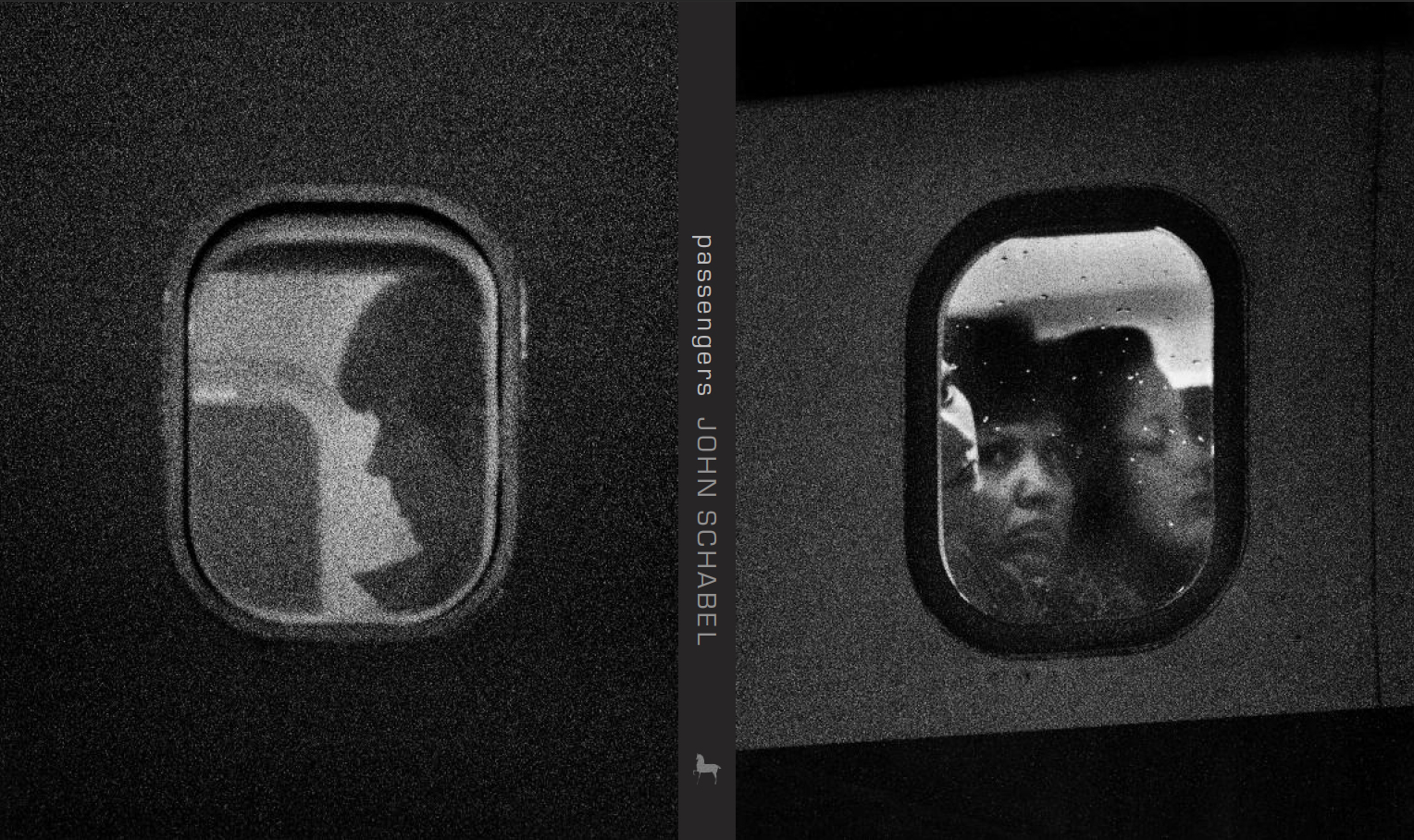
forthcoming from Twin Palms

"John Schabel’s series of photographs depicting anonymous airline passengers effectively captures the curious blend of impersonal efficiency and poignant humanity that pervades the experience of contemporary commercial air travel. Like products on an assembly line, the planes carrying Schabel’s subjects churn down the runway; and with the same regularity the individual passengers emerge, identically framed, from his camera and onto the gallery wall. Interestingly, it is precisely this mechanized process that lays bare the active, but often overlooked, emotional and intellectual relationship between human beings and flight.” — Laura M. Andre
 

Gary Briechle Twin Palms, 2012


The rocky coast of Maine is where Briechle found himself driven to make pictures, using the wet-plate collodion process, of the individuals who constitute his stand-in family. “I've been in Maine close to eight years now and there are some people I've photographed for the entire time. A few have died and I've shot their likenesses tattooed on the chests of those they've left behind.”

 Sailboats and Swans

Michal Chelbin, text by novelist A.M. Homes Twin Palms, 2012


There is nothing easy about it. It is a constructed moment, a scene within a scene, the real within the unreal. They are moments, lunga fermata, suspensions of time in the midst of what might otherwise be unbearable.

The images are about a kind of discomfort—theirs, hers, mine and ours. It is like an old fashioned staring contest—one guy looks at the other and the first one who blinks is the loser, except Michal Chelbin never blinks. Instead she captures with the click of a shutter. Chelbin is always looking, drawing what is hidden to the surface. She captures—we shudder. — A.M. Homes

+


1.28.2011

DIANA VREELAND: An Illustrated Biography

Diana Vreeland
Photograph (c) Priscilla Rattazzi /All Rights Reserved


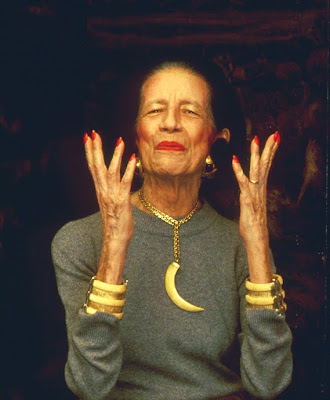
Diana Vreeland in her apartment
Photograph (c) Jonathan Becker /All Rights Reserved


Diana Dalziel, 1911 "I have always had a wonderful imagination, I have thought of things that never could be..." –Diana Dalziel diary


Diana Vreeland
Photograph (c) Louise Dahl- Wolfe /All Rights Reserved

Diana's friend Horst P. Horst photographed her in her "Garden in Hell." As she said in DV, "All my life I've pursued the perfect red. I can never get painters to mix it for me. It's exactly as if I'd said, 'I want Rococo with a spot of Gothic in it and a bit of Buddhist Temple' – they have no idea what I'm talking about. About the best red is to copy a child's cap in any Renaissance portrait." Photograph (c) Horst P. Horst


"There's an excellent profile in Interview in which Jeanne Moreau says: "I shall die very young." "How young?" they ask her. "I don't know, maybe seventy, maybe eighty, maybe ninety. But I shall be very young." – DV

Legendary fashion arbiter, Diana Vreeland, born Diana Dalziel in Paris in 1906 to an American socialite mother and British father, married businessman Reed Vreeland, and with their two young children, moved to London, where they spent six years. Vreeland made frequent visits to Paris; and befriended designers such as Patou, Schiaparelli and Chanel. Returning to the states in 1935, Vreeland wrote an inventive column for Harper's Bazaar, "Why Don't You?" and later became a top editor there. Vreeland photographed models in Frank Lloyd Wright homes instead of in staged studios. In 1963, she became Vogue's editor-in-chief during the "Swinging Sixties" youth quake era, traveling to exotic locales in Africa, India, Turkey, China, Japan, and South America with famed models of the time Jean Shrimpton, Veruschka, Penelope Tree and Twiggy. In 1971, Vreeland became the consultant to the Metropolitan Museum of Art Costume Institute, creating the most exquisite exhibitions; "The Glory of the Russian Costume" prepared with Jacqueline Kennedy Onassis; "Diaghilev: Costumes and Designs of the Ballets Russes"; "Imperial Style: Fashions of the Hapsburg Era"; "Yves Saint Laurent: 25 Years of Design"; "The Eighteenth-Century Woman", among many others. Mrs. Vreeland lived an artistic life, always fashionable and immensely creative. She died in 1989.

An illustrated Biography