Showing posts with label Nepal. Show all posts

11.01.2017

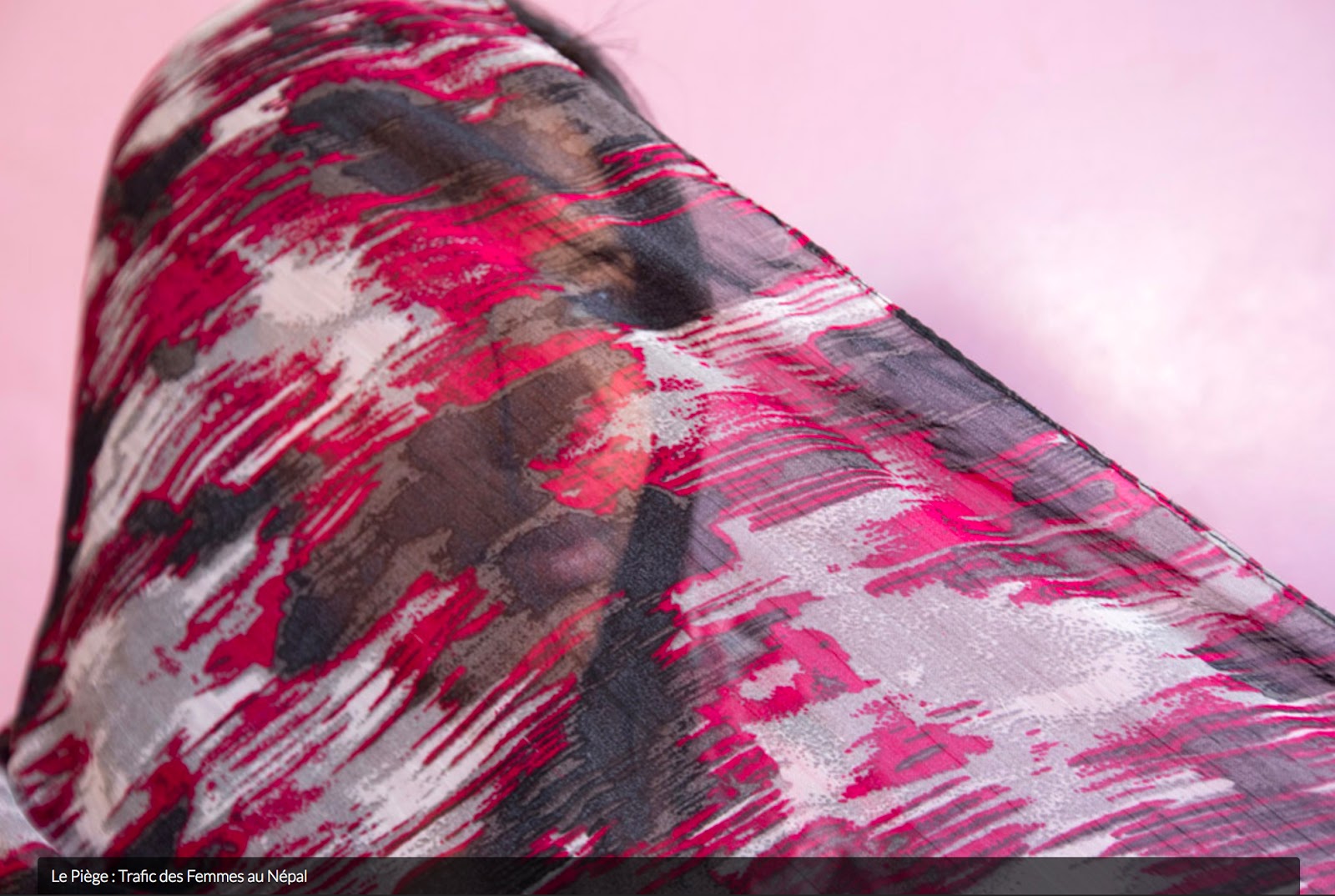
THE TRAFFICKING OF WOMEN IN NEPAL: Exhibition by Lizzie Sadin, Laureate of the 2017 8th Carmignac Photojournalism Award

 Photograph by Lizzie Sadin

Photograph by Lizzie Sadin

Photograph by Lizzie Sadin

 Photograph by Lizzie Sadin

Lizzie Sadin won the 8th Carmignac Photojournalism Award devoted to "Modern Day Slavery Among Women.” I was extremely honored to be on the jury.

+  +  +

Following a July 2016 call for applications by the Fondation Carmignac, the jury, presided over by Monique Villa, CEO of the Thomson Reuters Foundation and Founder of Trust Women, chose to give a voice to Nepalese women by selecting Lizzie Sadin’s project. After four months of reporting in the field between February and May 2017, the photojournalist has brought back a deeply moving testimony on gender-based human trafficking and how rooted it is in Nepalese society. An exhibition of this work opened October 20, 2017 at the Hôtel de l’Industrie, 4 place Saint-Germain-des-Près -75006 Paris, with an accompanying monograph.

After a devastating earthquake that killed 9,000 people and displaced 650,000 others in 2015, the daily life of many Nepalese was shattered. Unemployment and the extremely precarious living conditions have given rise to more and more traffickers every day.

To Lizzie Sadin, this trafficking, based on the sale and forced prostitution of women and girls by “friends” or even family members, is carried out not just for economic reasons, but also for cultural reasons. It affects a woman’s fundamental rights: the right to get a proper education, the right to control her own destiny, the right to live without fear of acts of physical or psychological violence inflicted by her own husband, the right not to be sold …An entire belief system that needs reversing: one that, in Nepal, defines women as being inferior to men.

The International Labour Organisation (ILO) estimates that there are more than 2.5 million victims of modern day slavery, and women make up the majority of this number. According to Amnesty International, women represent 80% of the victims of human trafficking, of whom nearly 50% are minors. The types of exploitation are numerous: sexual, forced labour, domestic slavery…

Women are all the more vulnerable in situations where they have little protection. The countries of South and South-East Asia as well as those of Central Europe and the ex-USSR are the principal purveyors of these modernday slaves. Although abduction is the most common route into slavery, women are also sold by their own families or entrapped into joining the networks of traffickers.

Armed conflicts exacerbate discriminatory and violent behaviour towards women. In Lebanon, Jordan and Turkey, numerous camps of Syrian refugees have emerged. These refugees provide easy prey for networks on the lookout for ‘merchandise’. In Nigeria, in the Darfur region of western Sudan and in the Democratic Republic of Congo,  women and girls are subject to abductions carried out to provide their kidnappers with sexual or domestic slaves.

+  +  +

Many thanks to Edouard Carmignac, President of The Fondation Carmignac; as well as to Emeric Glayse, Director of the Carmignac Photojournalism Award at Fondation Carmignac. The jury, chaired by Monique Villa, CEO of the Thomson Reuters Foundation and Founder of Trust Women, comprised of Elizabeth Avedon, independent curator specialized in photography • Francesca Fabiani, Photography Special Projects, Department for Contemporary Art and Architecture, Ministry of Culture, Italy • Thierry Grillet, Chief Curator of Bibliothèque Nationale de France (BNF) • Olivier Laurent, Editor-in-chief of Time Lightbox (now at the Washington Post) • Elisabeth Quin, journalist, writer and Arte TV Presenter (28 Minutes) • Narciso Contreras, laureate of the 7th edition of the Carmignac Award'

LIZZIE SADIN : EXHIBITION
The Trafficking of Women in Nepal
Laureate of the 8th Carmignac Photojournalism Award
October 20, 2017 to  November 12, 2017
Hôtel de l’Industrie, Paris
with an accompanying Monograph
Text courtesy of The Fondation Carmignac

8.27.2011

CLINT McLEAN: The Girl Who Married a Snake

Bolivia Salt
Photograph (c) Clint McLean

Elephants, from the series Dubaï World
Photograph (c) Clint McLean

Kumari in Throne
Photograph (c) Clint McLean

Four Brothers and the Hyenas
Photograph (c) Clint McLean

The Girl Who Married A Snake
Photograph (c) Clint McLean

Clint McLean is a photographer and Director of Photography based in Dubaï/Abu Dhabi, United Arab Emirates. Having worked in Canada for many of the major titles, McLean was brought to the UAE to help launch a new weekend magazine. The new magazine won many International Photography Awards before he moved into a role of content creation and launched The National's photography blog NationalView.ae.

McLean is also a fellow correspondent for La Lettre de la Photographie.
He's contributed several great pieces from Dubaï, such as Gazelle Samizay’s series Upon My Daughter and Alixandra Fazzina's Escape from Somalia, among others.

Returning to freelance photography and directing, Mclean is working on multiple long-term exhibition projects including ones on Salt and Fables.
So far, he's created fable based images in India, Nepal, Afghanistan, Ethiopia and Palestine. And, in case it's not evident, he doesn't use Photoshop for manipulation. There's no cut and paste, etc. The hyenas and the cobra are real and no images are combined.

I spoke with Clint recently and he explained about his ongoing projects:

"Salt is my first long term project. I have been working on it for over three years and there is no end in site. The series is a subtle way of looking at how simple things can have grand beginnings, or how great starts sometimes end humble. The often majestic Saltscapes make the end product seem somewhat pathetic, and emphasize the great changes through scale and context.

Dubaï World is a property development in the United Arab Emirates that never really got off the ground. The developer and the emirate have a great kitsch factor and no sense of irony which allows Dubai World to refer to both the development and the emirate.

The Kumari of Nepal are considered living goddesses and are chosen at about three years old to be spiritual leaders until they reach puberty at which time they return to being regular people. I have been following a number of current and former Kumari in this ongoing project. As in much of my work, there is an 'other-worldliness' to the Kumari which seems part real and part fairy tale.

The Girl Who Married a Snake (fables): This work is a series of staged images based on fables in various countries I have found myself in over the last couple years. The title of the series is taken from the first fable I staged which was in India. Folktales are an interesting insight into a culture, and the work becomes something between fact and fiction. Since the fables are part of the fabric of the society and culture, and the people, locations and props in the images are all authentic, there is a lot of true information in the staged images. Hopefully they help to add some context to places that people often have very narrow views of."

5.06.2010

CYCLING THE WORLD: Global Citizen Furtemba Sherpa Promotes Peace

"My Name is Furtemba Sherpa, I am a world Cyclist.
I have left Nepal December 25, 2003"

New York City

Italy

Helping in Haiti

Iguaçu Falls, South America

The Healing Center of "John of God"
Casa de Dom Ignacio, Abadiania, Brazil


Brasília

Furtemba Sherpa, World Tour Cyclist

"My name is Furtemba Sherpa, a Global Citizen. Originally, I am from a small village called Sankuasabha in Nepal. At the age of 26, I started world cycle tour with the cause of "World Peace and Environmental Protection." Since 2003, I had been cycling to 46 countries and intend to cycle 150 countries all together which should be done by 2020."

Furtemba Sherpa is the great-grandson of Tenzing Norgay, who first reached the summit of Mount Everest in 1953 alongside Sir Edmund Hillary. Conquering the Himalayas has been considered by most Sherpas in Nepal as the pinnacle of success, but Furtemba is embarking on his dream to become the first Sherpa to cycle around the globe to promote his message of World Peace and Environmental Protection.

9.10.2009

KEVIN BUBRISKI: Pilgrimage

Tamang Girlfriends, Yarsa Village, Nuwakot, Nepal, 1984
(c)
Kevin Bubriski/All rights reserved


Tamang Women, Gatlang Village, Rasuwa, Nepal, 1984
(c)
Kevin Bubriski/All rights reserved


Pilgrimage: Looking at Ground Zero
Photographs by
Kevin Bubriski / Powerhouse Books

KEVIN BUBRISKI, an American documentary photographer, is the recipient of fellowships from the Guggenheim Foundation, the Fulbright Foundation, the National Endowment for the Arts, and the Asian Cultural Council. Bubriski's work has been exhibited internationally and is in the permanent collections of New York's Museum of Modern Art, The Metropolitan Museum of Art, and the International Center of Photography; the San Francisco Museum of Modern Art; Yale University Art Gallery, New Haven; the Center for Creative Photography, Tucson; and the Bibliothèque Nationale, Paris. Bubriski spent nine years living and photographing in Nepal while also photographing in nearby India, Tibet and Bangladesh. This work can be seen in his books, Portrait of Nepal and Power Places of Kathmandu.

Bubriski's book, Pilgrimage: Looking At Ground Zero
, images shot following 9/11 in the streets surrounding Ground Zero in NYC, was recently reviewed in The Photo Book by Douglas Stockdale here. "In these photos, the World Trade Center is nowhere in evidence, except in the stunned expressions on the faces of the people now confronting the sight of its obliteration."
Power House Books

Kevin Bubriski Website
Fine Art Photography Masters: Bubriski Portfolio