Showing posts with label Nature. Show all posts

5.01.2019

MYTH OF A WOMAN : Agnieszka Sosnowska

 My Belt, Héraðsandur, Iceland, 2011
© Agnieszka Sosnowska

 Self Portrait for Rodin, Kleppjárnsstaðir, Iceland, 2012 
© Agnieszka Sosnowska

 Self Portrait. Mjóifjörður, Iceland, 2013
© Agnieszka Sosnowska

 Longbow Practice. Self Portrait. Kleppjárnsstaðir, Iceland, 2018
© Agnieszka Sosnowska
 
“The Icelandic landscape is beautiful, but brutally unforgiving. There is majesty in the black cliffs and glaciers, but harsh winds and long winters render them dangerous for part of the year . . . a place both alluring and treacherous, Iceland is the perfect metaphor for Agnieszka Sosnowska’s photographs about the dichotomies of womanhood.” 
– Kat Kiernan, Myth of A Woman monograph 


Self Portrait. Nude, Landsendi, Iceland, 2015
 © Agnieszka Sosnowska

 Rúnar. Fremrasel, Iceland, 2018
© Agnieszka Sosnowska

 The Doll. Self Portrait. Reykjavik, Iceland, 2018
© Agnieszka Sosnowska

Photographer Agnieszka Sosnowska, exhibition of over fifty photographs, Myth of A Woman, is opening at the National Museum of Iceland May 4th, 2019. The core of the almost fifty photographs began with Sosnowska's intention to interpret the poem, “Móðir mín í kví, kví,” in a series of self-portraits in the East fjords of Iceland shot in many of the same places from where these stories originated.

Throughout Iceland’s history, women that bore children from circumstances that were not acceptable at the time - either shamed by the pregnancy or afraid their families or society would dismiss them - would leave their newborns out in the wilderness to die of exposure. “Móðir mín í kví, kví,” tells of a woman haunted by the voice of her abandoned child and driven to madness by her choice. Sosnowska has stated she is unable to bear children and this painful fact had affected her sensibility. In this way she connected with these Icelandic women and their sacrifices; to have the ability of motherhood taken away from you by means out of your control can be consuming. The result is a unique body of work, using a 4X5 view camera to create these mythical images.

+  +  + 

I was deeply touched by Agnieszka Sosnowska’s intensely personal self-portraits in a 2015 photo-documentary on LensCulture, years before meeting her in person at The Icelandic Photography Festival 2018. I was honored to have the opportunity to curate this exhibition, creating a path through her personal journey. I spoke with Ms. Sosnowska, currently living on a farm outside of Egilsstaðir, Iceland, about her early work and recent and past influences:

EA: What age did you begin to photograph?

AS:
I was 18 years old when I started making self-portraits as a student studying photography. I am 47 years old now and am still creating them. My professors at Massachusetts College of Art were Abe Morell, Laura McPhee, Barbara Bosworth, Nick Nixon, and Frank Gohlke. Their work ethic as professors and working artists was and still is intense. As teachers they constantly questioned why you are doing what you are doing. The program was tough. You had to deliver new work on a weekly basis and the critiques were brutally honest.

As a student, I would take the bus from Mass Art to the Arnold Arboretum in Jamaica Plain to photograph. I was visually interested in the trees and unusual plants that grow there. It took years of traveling and growing up to acquire the skills and courage of how to photograph people. To gain a person’s trust and comfort for a photograph is truly an art form.

Over time I started to place myself into the pictures at the Arnold Arboretum. I wanted to play with the composition and scale in nature. It was a matter of convenience to use myself. This convenience turned to challenge. I realized that it was not where I positioned myself into the frame but how I reacted to what was around me. What was the story? What was I trying to say? How could I make it convincing?

EA: Who were your mentor’s or photographers you admire?

AS: I am mostly influenced by filmmakers, painters, musicians and writers. As a teenager I loved Jim Jarmusch films. “Down by Law” and “Stranger Than Paradise,” taught me that black and white can be complete colors to tell a story. In college I discovered Frida Kahlo paintings. She taught me that your life can be a story. It is important enough.

The music of Kate Bush and PJ Harvey have inspired narrative in my thought process. Listening to Bush’s “Hounds of Love” as a teenager and Harvey’s “Let English Shake” was a visual experience. Those albums are masterpieces. “Into the Wild” by Jon Krakauer had a huge influence on my life. Fifteen years ago while camping in the wilderness of Iceland I would read passages from this book to my husband. This book awakened me. You can live life or wait for it to take you.

I am drawn to photographers that work with people or a place over a long period of time. It means something to them. It isn’t a project that the artist sets out to conquer. They are living it. They are the story they are telling. In order for me to keep looking at an image I have to feel it. There has to be a real connection. No matter how unbelievable the photograph might appear, you end up believing it.

Contemporary photographers I deeply admire are…Chris Killip. His 4X5 series entitled “In Flagrante” is an inspiration. He understands what it means to become part of a community in order to tell a story about it. LaToya Ruby Frazier. Her self-portraits. Wow! What a series. In my opinion she is the most important photographer living today; Mike Brodie. His portraits of his friends train hopping. He is a poet. Nan Goldin. Her portraits of her lovers and friends. Her honesty is uncompromising.

These photographers deliver such honesty in their work that it stays with you. Their photographs are able to connect and communicate to a wide range of viewers. They have something to say. Their language is universal and it stays with you long after you see it.

EA: Has living on your farm in Iceland changed your perspective?

AS: Absolutely. My husband, Runar, and I made a conscious lifestyle choice to live as we do. He and I have nothing in common as far as hobbies go but what joins us is our love of nature. We both wanted the same lifestyle and we took a chance on each other. We own 400 hectares of land with lakes. It is private and isolated even by Icelandic standards. It is very quiet and special. I can't imagine living anywhere else. I have become self reliant and independent. When problems arise, you have to solve them yourself. It’s made me stronger both physically and mentally.

EA: Why did you choose to live in Iceland?

AS: Since immigrating to Iceland 10 years ago I’ve been asked this often. My reasons range from the rural lifestyle that I’ve adopted here, a good job, beautiful nature, and more often my response ends on the topic of Icelandic women. In my eyes the female spirit in Iceland encompasses strength and community. This strength has served as an inspiration in my life as an immigrant in this new land I now call my home. 

 +  +  + 

A catalogue will accompany the exhibition, Myth of a Woman, with a preface by Inga Lára Baldvinsdóttir, Museum Exhibitions Director; a foreword by Icelandic poet, Ingunn Snжdal; an introduction by Kat Kiernan, Director, Panopticon Gallery; and an essay by Agnieszka Sosnowska. 31 duo-tone images, 9.5 x 11,” 41 pages, soft cover (Fall, 2019).

MYTH OF A WOMAN
Agnieszka Sosnowska
May 4th. 2019 – Sept 1, 2019
Curated by Elizabeth Avedon
 
Þjóðminjasafn Islands
National Museum of Iceland, Reykjavнk 

Agnieszka Sosnowska is represented in the U.S. by Panopticon Gallery

7.04.2017

The Best of LensCulture, Volume 1

The Best of LensCulture, Volume 1 (Schilt Publishing, 2017)

 © Justine Tjallinks

© Gareth Bragdon

© Matic Zorman

"The language of photography continues to get more interesting and more complex as it becomes the most universal medium of communication worldwide.” – Jim Casper, founder of LensCulture

+  +  +

LensCulture's first book, The Best of LensCulture, Volume 1 (Schilt Publishing, 2017) features contemporary photographers from all over the world, discovered during four of LensCulture’s annual competitions. Not only are these photographers geographically diverse, but their work encompasses many different genres.

For those of you who don't know, LensCulture is a global network and online magazine. For new, emerging and established photographers– it means exposure. THE place to be seen. "For almost 10 years, LensCulture has become one of the most authoritative resources for contemporary photography – currently reaching a monthly audience of over 2 million people around the world. They have been committed to discovering and promoting the best of the global photography community. They look for exciting work from every continent, and from diverse points of view: documentary, fine art, nature, photojournalism, activism, street photography, sports, fashion, poetic, personal, abstract and human. LensCulture International Exposure Awards, now in their 5th year, are granted yearly to discover, reward, and promote new, emerging, and established photographers from around the world."

"The range of work in this book is wide and diverse—from portraits to street photography, photojournalism, personal stories, documentary, fine art, fictional narratives, poetic beauty and abstraction. Their images will take you on a tour of the world and introduce you to people, cultures, historic events and the wonders of nature. Their imagery will also help you appreciate the richness of photography itself as a powerful creative language in all its variety. Who are the people practicing this profound universal language with “fluency” in our image  saturated world today? This book attempts to answer that question. The editors of this volume believe it takes the critical eyes of curators and experts in the field to discover and celebrate true excellence, finding those images that stand out from the crowd and deserve our considered attention."

"The photographers were discovered through four international photography competitions sponsored by LensCulture in the past year. These awards attract entries from photographers all over the world—individuals who have chosen the medium of photography as the best way to communicate and share their experiences, personal visions and points of view. This book is designed as a resource for inspiration, a reference guide, and a point of departure that will allow you to discover amazing photographs and stories." 

Design: Heijdens Karwei, Amsterdam.
ISBN 978 90 5330 862 2
Schilt Publishing 

  © Martin Venezky, Barbara Levine


© Frank Herfort

Many thanks to Schilt Publishing for much of the text and images. And to LensCulture's Jim Casper for his enormous efforts in discovering and showcasing the world’s best new, emerging and established contemporary photographers and multi-media creators, and bringing them into our lives.

5.29.2015

SARAH MALAKOFF: Second Nature + Photolucida + The Photoville Fence

Untitled Interior (deer couch), 2010
Photograph @ Sarah Malakoff

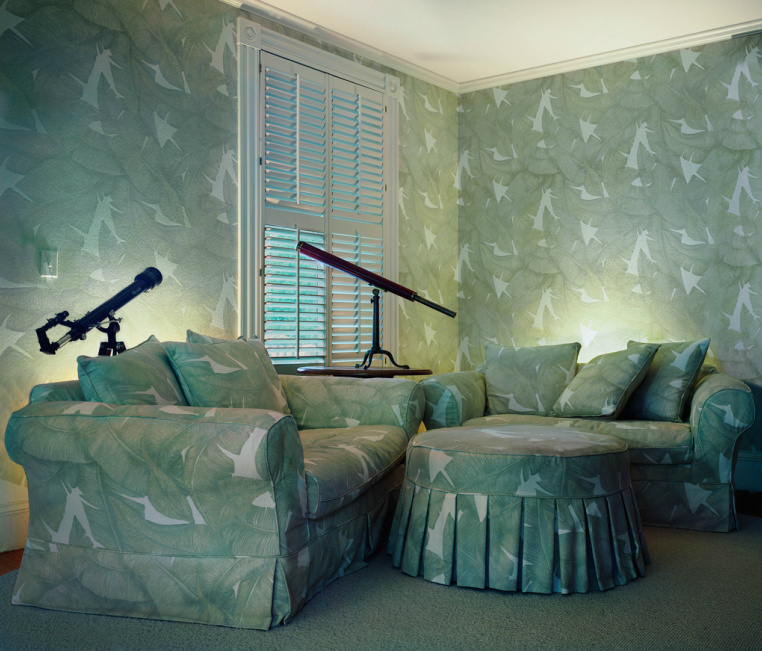
Untitled Interior (telescopes), 2011
Photograph @ Sarah Malakoff

Untitled Interior (fur wall), 2012
Photograph @ Sarah Malakoff

“Sarah Malakoff’s large-format photographs of domestic interiors appear at once familiar and strange. In her exquisite and psychologically resonant images, the rooms become both a refuge from and a reinvention of the world outside. As Linda Benedict-Jones writes in her introduction to Malakoff's book "Second Nature" published by Charta, “.....we walk through rooms large and small where brightly patterned curtains and dark wood paneling take over, as canoes become coffee tables and living rooms accommodate tree trunks....Each space is carefully transcribed in the warm vocabulary of contemporary color photographs, creating an ensemble greater than the sum of its parts.” Boundaries between inside and outside, shelter and vulnerability, the real and the imagined all become blurred. Malakoff’s formally precise compositions set the stage for viewers to imagine the characters that reside within.” I was fortunate to meet Sarah Malakoff at the 2015 Photolucida Portfolio Review in Portland, Orego. You can view her work this summer in Brooklyn on Photoville's 2015 FENCE.

"Second Nature" by Sarah Malakoff 
(Publisher: Charta)


3.14.2015

ANNA AGOSTON: "Untitled" Living Plant Elements Found In Nature

Photograph © Anna Agoston

 Photograph © Anna Agoston

 Photograph © Anna Agoston

"Untitled" 174 black-and-white macro photographs of living plant elements found in nature... 

A resident of Brooklyn, New York, Anna was born and raised in Paris, France. Always passionate about art, she qualified as an architect DPLG (government-certification) at the Ecole d'Architecture Paris Malaquais, and went on to earn the M.Arch.II degree in architecture at Harvard University's Graduate School of Design. There, she studied fine art photography under Professor Jim Dow of the Department of Visual and Environmental studies, and photographed her first series, “Dorm.” In October 2013, Anna made her lifelong passion, fine art photography her main professional occupation. I met Agoston at the 2015 powerHouse Portfolio Review.

7.31.2013

ELLEN JANTZEN: Disturbing The Spirits

Let The Others Follow
 © Ellen Jantzen

Toward Profusion
 © Ellen Jantzen

Into The Unknown
 © Ellen Jantzen

Encounter
 © Ellen Jantzen

"In Disturbing the Spirits I am using imagery to convey my feelings about the state of nature, the nature of trees, and how to express their connection to past, present and future. By obscuring a portion of the image through a veil, I strive to heighten the remaining reality through discovery and reflection."
–Ellen Jantzen

Disturbing the Spirits
 
These are a few images from Ellen Jantzen's newest series, Disturbing The Spirits. This series deals with both reality and time (past/present/future) and her growing attachment to the healing powers of the natural environment.

Trees teach us about belonging; they remind us that life doesn’t need permission to prevail. Trees are sanctuaries. If we listen closely, we can learn the ancient law of life. They are seen as powerful symbols of growth, decay and resurrection.They have played a prominent role in many folktales and legends and have been given deep and sacred meanings.

But, a tree’s longevity can lull us into a false sense of immortality. It is this very impermanence that I long to understand through my photographic explorations. There is an ineffable natural beauty.... too great to be expressed or de-scribed in words." (Text: Ellen Jantzen)

Ellen Jantzen was awarded PX3's First Prize in the 2013 Prix de la Photographie Paris Competition for her series Transplanting Reality; Transcending Nature.

8.18.2011

MARIANA COOK: Stone Walls

Window and Walls, Machu Picchu, Peru
Photograph (c) Mariana Cook

Terraces. Ollantaytambo, Peru
Photograph (c) Mariana Cook

Limestone Field with Puddle. Inishmaan, Ireland
Photograph (c) Mariana Cook


Stone Walls: Personal Boundaries was conceived by Mariana Cook, the last protégé of Ansel Adams, at her home on Martha’s Vineyard on the day before Thanksgiving in 2002. After 56 cows strayed through a crumbling section of the stone wall she shares with her neighbor, Cook studied the tumbled wall and was struck by its beauty. With that inspiration, Cook spent eight years traveling to farms, towns, and temples in Peru, Great Britain, Ireland, the Mediterranean, New England, and Kentucky in pursuit of dry stone walls.

Work by Mariana Cook is in the collections of The Museum of Modern Art and The Metropolitan Museum of Art, New York; the Los Angles County Museum and the J. Paul Getty Museum in Los Angeles; the Corcoran Gallery of Art and the National Portrait Gallery in Washington, D.C.; and the National Gallery and the Victoria and Albert Museum in London, among others. Previous books: Fathers and Daughters, Mothers and Sons, Generations of Women, Couples, Faces of Science, and Mathematicians. She lives in New York City with her husband and daughter.

6.01.2010

ROSE-LYNN FISHER: -BEE-

tarsus
Photograph (c) Rose-Lynn Fisher/All Rights Reserved

the bee's knee
Photograph (c) Rose-Lynn Fisher/All Rights Reserved

eye
"The first time I looked at a bee’s eye magnified I was amazed to see a field of hexagons, just like honeycomb" Photograph (c) Rose-Lynn Fisher/All Rights Reserved

BEE, Photography by Rose-Lynn Fisher
Princeton Architectural Press

"As though revealing a secret, the scanning electron microscope presents a realm of structure, design and pattern at a level of intricacy we are oblivious to in our daily experience."–rose-lynn fisher

An Afternoon with the Artist: June 19 1-5 PM

4.22.2010

PENTTI SAMMALLAHTI: Contemporary Finnish Photography

Cilento, Italy, 1999
Photograph
© Pentti Sammallahti/ All rights reserved


Helsinki, Finland, 1973
Photograph
© Pentti Sammallahti/ All rights reserved


Solovki, White Sea, Russia, 1992
Photograph
© Pentti Sammallahti/ All rights reserved


Varanasi, India, 1999
Photograph
© Pentti Sammallahti/ All rights reserved


Vicki Bohannon, photo-eye Galleries Photographer-at-Large (Vicki creates those perfect Book Tease's as well as redesigning and rebuilding the Gallery space for every new installation), has been a great champion of Pentti Sammallahti long before he became well known outside of photography circles. His exquisite toned gelatin-silver prints are often wait listed.

"Pentti Sammallahti is a benchmark figure in contemporary Finnish photography. His works depict nature eroded and broken down by civilization, but he does not put man and the environment in opposite camps. He sees an equal relationship, in which the power of brotherhood stemming from the environment frees man of his alienation and cosmic loneliness. Sammallahti is also known as a passionate seeker of the perfect printing method. The Opus series, launched by him, is an integral feature of contemporary Finnish book art."–photo-eye

10.25.2009

JOSE LUIS RODRÍGUEZ: Veolia Environment Wildlife Photographer of the Year 2009

Camera: Hasselblad 503CW
The Storybook Wolf (c) José Luis Rodríguez /All Rights Reserved

JOSE LUIS RODRIGUEZ won this year's Veolia Environment Wildlife Photographer of the Year 2009 Award, beating 43,135 entries from 94 countries and in over 17 categories. "In Spain, the population of Iberian wolves is thought to number 1000-2000 in the north, with a few isolated populations in the south. José Luis risked a slow shutter-speed to reveal the moonlit sky and conjure up the atmosphere of the place. He switched from using his Nikon D2X to a Hasselblad for the exact framing he had in mind." The 2010 competition launches in January. (UK Natural History Museum)

José Luis Rodríguez Gallery

10.07.2009

RUSS MARTIN: Nature Category

Shaggy White Dahlia
Photograph (c) Russ Martin
/All rights reserved

The Hosta Project
Photograph (c) Russ Martin/All rights reserved

Wilted Hostas
Photograph (c) Russ Martin
/All rights reserved

RUSS MARTIN won first place in the International Photography Award (The Lucies) in the Nature: Flowers category for his Hosta Flowers series. The Hosta Project 2006-2009 won the PX3 PRIX DE LA PHOTOGRAPHIE PARIS in the Nature category. View the Hosta Project Book. Martin is represented by Contemporary Works. Russ Martin Website

9.24.2009

NICK BRANDT: A Shadow Falls

Elephant Drinking, Amboseli, 2007
Copyright (c) Nick Brandt
/All Rights Reserved

Rhinos in Lake, Nakuru, 2007
Copyright (c) Nick Brandt
/All Rights Reserved

Portrait of Two Zebras Turning Heads, Ngorongoro Crater, 2005
Copyright (c) Nick Brandt
/All Rights Reserved

Ostrich Egg Abandoned, Amboseli, 2007
Copyright (c) Nick Brandt
/All Rights Reserved

September 25-November 28, 2009
Nick Brandt: A Shadow Falls
Photo-Eye Gallery, Santa Fe

Brandt's New Book A Shadow Falls Published by Abrams

8.27.2009

MARCIA MARTIN: Lucies Nature Award

Stillness (c) Marcia Martin/All rights reserved

Leaf and Sparkles (c) Marcia Martin/All rights reserved

MARCIA MARTIN won an International Photography Award (The Lucies) in the Nature category for her Portfolio of Floating Leaves. Martin is represented by Contemporary Works. Marcia Martin Website

7.12.2009

FERNANDO DELGADO: The Architecture of Nature


 Turning Point © Fernando Delgado / All rights reserved
Click images to enlarge

Palm Yucca Bud © Fernando Delgado / All rights reserved

Anthurium No. 2 © Fernando Delgado / All rights reserved

It is only natural after 25 years contemplating, scrutinizing and promoting images, that I find myself behind the camera making images

+ + +

FERNANDO DELGADO was born in Cuba in 1957 and moved with his family to the U.S. when he was 12. In 1975 he attended The Cooper Union School of Art in N.Y., studying with prominent graphic designers Milton Glaser and Herb Lubalin. After Cooper Union, he had the opportunity to study with renowned art director Henry Wolf, artist Louise Nevelson and photographers Steven Meisel, Helmut Newton and William Klein at Parsons School of Design.

As a Creative Director for 25 years, Delgado successfully worked with an impressive list of clients such as Bloomingdale's, Macy's, Young & Rubican Advertising, among others. He co-authored
a collection of French fashion photographer Guy Bourdin's innovative, surreal and erotic images in the book Exhibit A: Guy Bourdin. In 2005, he moved to Placitas, New Mexico from NYC and returned to his first love, making images, embarking on a successful career as a fine arts photographer.

Photographed using natural light, the Botanical series The Architecture of Nature (above) was inspired by Karl Blossfeldt’s botanical studies for use by architects. I recently spoke with Fernando Delgado in Santa Fe:

ELIZABETH AVEDON: Tell me about your experience studying with Louise Nevelson.
What stage of her life did you meet her? Your photographs in your COMPOSITIONS series are reminiscent of her work.

FERNANDO DELGADO: In 1979, a group of students from Parsons had the opportunity to be part of a seminar at Louise Nevelson's studio on Spring and Mott, before that area was even called SOHO.

On the first day, Ms. Nevelson (as she liked to be called), sent us out on a hunt on garbage day. The directive, to bring back any forms or shapes that intrigued us. The criteria for selection was open to anything that interested us in whole or in part. During the course of the remaining days, we witnessed her creative process of examining, eliminating, cleaning, and careful storage of some of our treasures (in wooden barrels) with the promise of one day being used on a Nevelson work.

Although the class had more to do with sculpture, we also saw her prints, collage, drawings and other work in progress. The studio was small, crammed, but orderly and surprisingly clean. This was towards the end of her life, since she died 9 years later in 1988. Ms. Nevelson, was in a word, eccentric, but also very real. She spoke her mind and she did it openly and eloquently. I was mesmerized and at times very much amused, and I dreamt that one day I too would enjoy that freedom and clarity not only in my work, but also as an artist. From Ms. Nevelson, I learned to be a good editor, the complex power of inspired simplicity and a renewed appreciation for form, light and space.

EA: I am in awe of William Klein. Did you study with him, work for him? Please explain...

FD: During my years at Parsons (1977-1981), my fascination with Fashion kicked into full gear. During my years as an illustration major, I was first exposed to the work of Guy Bourdin, studied Fashion Illustration with Steven Meisel, attended workshops with Helmut Newton and booked models through the school's Model's Office for Robert Mapplethorpe.

In my senior year, I had the opportunity to study with Henry Wolf and William Klein, who were pivotal in my switch from illustration to photography. With Wolf, I learned to trust my photographic instinct and with Klein to understand photography beyond the still camera. The first session was devoted to watching his film Qui êtes-vous, Polly Maggoo where the world of fashion on film is at once, fiction and reality. I was fascinated by the craft of film-making and the vast numbers of talent necessary to make it happen. It was performance art, very public and quite different from the seemingly insular world we experienced with Louise Nevelson. His teaching style was unstructured and discussions would range from technique to philosophy. From William Klein I learned to see in motion, humor, layering, composition and the power of black and white imagery, and most of all to have fun and be in the moment.

Exhibition: NaturalMente
National Hispanic Cultural CenterJuly 17th, 2009 - January 2010

Fernando Delgado Photography: Upcoming Exhibitions
www.Fernandodelgadophotography.com

An Interview

5.04.2009

MUENCH FAMILY: Three Generations of Photographers in Monument Valley

Father
The Double Arch, Arches Nat'l Park, Utah.
Photograph (c) Josef Muench/All rights reserved

(Click Image to Enlarge)

Son
Wilson Arch, Moab, Utah. Photograph (c) David Muench/All rights reserved


Grandson
Stevens Arch, Utah. Photograph (c) Marc Muench/All rights reserved


JOSEF MUENCH was born in Bavaria in 1904. At the age of 11 he received his first camera and began a lifelong interest in capturing nature on film. He arrived in the United States with his brother in 1928 and eventually settled in California.

In the 1930's, Monument Valley remained virtually unknown (except to the Navajo whose name for it is Tsé Bii' Ndzisgaii Valley of the Rocks) until Muench took some of the most memorable photographs of it beginning in 1936 and returning over 350 times to photograph there. In 1938, he met with the editor of Arizona Highways Magazine who ran Josef's photograph of the Rainbow Bridge National Monument. Not long after, Muench's name became synonymous with Arizona Highways Magazine where he worked for more than 50 years, using mostly his 4x5 camera.

Later he also photographed in Africa, Alaska, Asia, Canada, Europe, Hawaii, the Rocky Mountains and beyond. The unmanned Voyager Expeditions, launched in 1977, included his photo of a snow-covered Sequoia redwood taken in Kings Canyon National Park. Josef Muench died in 1998 at the age of 94, but his legacy remains.
+ + +

DAVID MUENCH, an innovator in landscape photography, has said that nature is his greatest teacher. Son of the founding father of color landscape photography, Josef Muench, and father of Marc Muench, David contributes to the world of photography by illustrating the beauty of land. Best known for his unique view of the American western landscape, he has presented us with the clear lakes and wild rivers of this country for more than 50 years. Muench's formal schooling included the Rochester Institute of Technology, Rochester, New York, The University of California at Santa Barbara and the Art Center School of Design, Los Angeles, California.

No permits or plane tickets were contemplated when Muench first traversed the Western landscape with his adventurous parents. His father photographed, while his mother, Joyce, wrote about their experiences. The family would travel from their home in Santa Barbara to the eastern Sierras, still one of David’s favorite places, or to the desert Southwest, taking airboats up the Colorado River or animal pack trips deep into the canyon lands.

William Conway, the former president of the Wildlife Conservation Society, praised David as one of the most “prolific and sensitive recorders of a rapidly vanishing natural world” while setting the standard and raising the bar for color landscape photography. David was commissioned to provide photographs for 33 large murals on the Lewis and Clark Expedition that hangs in the Jefferson Expansion Memorial in St. Louis. He is widely published in more than 60 books and publications.

+ + +

MARC MUENCH, as a third-generation photographer, could easily have fallen under the shadow of his talented father and grandfather. Instead, he's emerged as an acclaimed landscape and sports photographer in his own right since finishing his studies at Pasadena Art Center College of Design.

Muench estimates that his family has archived 250,000 individual 4x5 transparencies over the years, which is the primary statistic that drove the family studio to a digital workflow. Muench explains that their first foray into digital photography was to hire an employee to run the drum scanner they had purchased and digitize their work. Since that time their family photography studio has fully embraced digital work from capture to print.

Working alongside his parents at the studio, Marc has collaborated on and published several landscape photography books with his father, and his photography has appeared on the covers of Time, National Geographic, Traveler, Arizona Highways, Ski, Skiing, Outside, and Sierra Magazine. He was designated as a Kodak Photo Icon and recently published his 9th book. Marc leads 5 day intensive Photography Workshops, exploring areas like Patagonia, Scotland and Utah, among other remote and beautiful landscapes.

Marc Muench
"Wild Utah" Photography Workshop October 1-5, 2009
Muench Stock Photography
Monument Valley in Vanity Fair Magazine