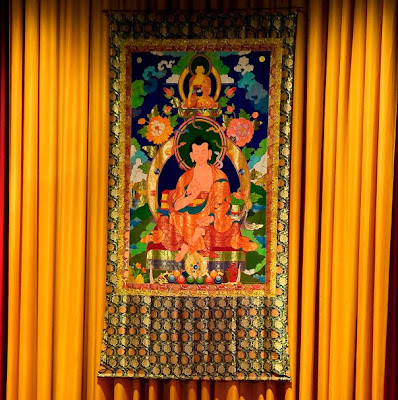
 Nagarjuna, Tibetan Applique Thangka, 18' tall x 9' widePhotograph (c) Herman Velez /All Rights Reserved
 HH The Dalai under Nagarjuna's Thangka
Photograph (c) Herman Velez /All Rights Reserved
(please click image to enlarge) HH The Dalai Bestowing Blessings at Radio City Music Hall, NYC
Photograph (c) Herman Velez /All Rights Reserved
Nov 5th • DUMBO 1st Thursday Walk: Until 8:00 Pm
THE TIBET CENTER is the oldest Tibetan Buddhist Center in NYC. It's not a Gallery, but you are welcome to come and look around Thursday evening. On display is the 18 foot tall (rolled to 12 foot to mind the ceilings) Nagarjuna Applique Thangka that was commissioned for HH The Dalai Lama. Other Tibetan paintings of the Buddha, White and Green Tara's, among other traditional pieces, are also on display.
The Tibet Center has moved out of Dumbo since I first posted this piece and is now located at the University Settlement/Houston Street Center, 273 Bowery x Houston St, New York City.
+ + +
THE 18 foot tall NAGARJUNA Applique Thangka was commissioned for The Dalai Lama's three days of Teachings on The Diamond Cutter Sutra by the Buddha and Seventy Verses on Emptiness by Nagarjuna. To begin, a request was made to the Master Tibetan Applique Artist, Dorjee Wangdue, in Dharamsala, India.
T. G. Dorjee Wangdue was born in Lhasa, Tibet in 1962. At the age of 16, he joined Namgyal Tantric Monastery of H.H. the 14th Dalai Lama. It was his teacher, Ven. Thupten Jamyang (late), a Kalachakra ceremony and ritual master assisting H.H. the 14th Dalai Lama, who encouraged him to learn and improve his natural talent in making religious images of applique. He later opened the Tibetan Applique Arts Training Centre in Dharamsala, where over 150 young Tibetans have learned this unique Art so far.
After The Tibet Center's request was placed, Master Dorjee Wangdue had a Thangka Painter from HH's own Namgyal Monastery make a pencil sketch of the Buddhist images for the huge piece. HH The Dalai Lama made adjustments to the sketch asking that the figure of the Buddha be placed above the central figure of Nagarjuna. The Applique Artist then designed the placement of all of the individual pieces and gave this to a team of crafts men and women who worked on it for many months. It was hung above HH The Dalai Lama in Radio City Music Hall, NYC, in 2007 and now resides in DUMBO.
+ + +
VIDEO'S
 Richard Gere and Khyongla Rato Rinpoche, with HH the Dalai Lama's senior tutor, Kyabje Ling Rinpoche (embalmed body d. 1983), Dharamsala, India 1988. Photograph (c) Elizabeth Paul Avedon /All Rights Reserved
 Greetings From The Mountains In Taiwan
 Khyongla Rato Rinpoche, Taiwan



 Posts
Posts

