Showing posts with label Life Magazine. Show all posts

11.03.2016

KACPER KOWALSKI: Fade To White

 Copyright © Kacper Kowalski. All rights reserved

 Copyright © Kacper Kowalski. All rights reserved

 Copyright © Kacper Kowalski. All rights reserved

Copyright © Kacper Kowalski. All rights reserved

Fade To White 
by Curator Bill Shapiro

Before Kacper Kowalski was a fine-art photographer, he was a pilot . . . and before he was a pilot, he was an architect. So perhaps it’s not surprising that he looks at the world the way an architect looks at his blueprints: from the top down. Of course, in these days of drones and Google Earth, it’s hard to bring people a landscape they haven’t seen before. Which is precisely what makes Kacper’s pictures so remarkable: From his paraglider, 500 feet above the earth, he turns everyday locations into striking ethereal scenes, capturing a symmetry, drama, and dreaminess we didn’t know was there.

We’ve all seen the work of high-flying aerial photographers who travel to exotic locations and bring us back bird’s-eye images of the Great Wall, Great Pyramids, or Great Barrier Reef. But Kacper made the decision long ago to uncover beauty in the humble forests, working farms, and industrial landscapes within driving distance of his home in Gdynia, Poland, a port city on the Baltic Sea. And so he obsessively crisscrosses the area, often during the coldest, most forbidding days of winter when he has the skies to himself.

When I was the editor of LIFE magazine, I was continually nudging the staff to “show us something we’ve seen before in a way we’ve never seen it.” This is actually incredibly difficult, and yet Kacper does it with each image. He can photograph a place we might pass every day, but compose the picture so masterfully as to render it as a never-before-seen abstraction—a visual puzzle open to interpretation. That sense of surprise is one of the reasons I love curating his work: Sometimes you have no idea what you’re looking at even while it feels incredibly familiar. Holding those two sentiments at the same time is exhilarating. In that way, Kacper’s pictures are like moon rocks: prosaic in one sense and at the same time absolutely alien and absolutely thrilling.

Kacper’s previous project, Side Effects, focused on the friction between mankind and nature, and the discordant beauty that that conflict reveals. His latest work, a series titled Over, looks at the land after that struggle has been decided; he captures the traces of mankind upon a quiet Earth where you feel the presence of humans but never quite see them.

Kacper’s photographs (as well as his book, Side Effects) have been honored with numerous awards, and his work has shown everywhere from Paris and Beijing to Copenhagen, Vienna, and Moscow. But his exhibit opening at The Curator Gallery this week is only his second in the United States, and I feel fortunate to be able to bring seen-it-all New Yorker's a little something they haven’t seen before.  – Curator, Bill Shapiro

 The Curator Gallery, Chelsea
520 West 23rd St, NY
November 3 – December 17, 2016
Curated by Bill Shapiro

Kacper Kowalski’s photographs have been honored by World Press Photo (2009, 2014, 2015) and Picture of the Year International (2012, 2014, 2015, 2016), among many others. His first book of photography, Side Effects, received awards from Photo District News and the Moscow International Foto Awards. He lives in Gdynia, a port city in northern Poland.

Bill Shapiro served as the Editor-in-Chief of LIFE, the legendary photo magazine and, later, as the founding editor of the award-winning website LIFE.com.  He is currently the Director of Editorial & New Business Enterprises at Fast Company and sits on the Art Advisory Board for the SXSW festival.


9.21.2014

SAUL LEITER: Early Black and White Photography from the 1940's and 50's

Jean, c. 1948
Courtesy of Howard Greenberg Gallery

Scarf, c.1948
Courtesy of Howard Greenberg Gallery

Debra and Regina, c.1948
Courtesy of Howard Greenberg Gallery

‘He has a rapturous way with color, which stems from his love of the masters of modern art,’ writes Max Kozloff in the introduction to "Saul Leiter: Early Black and White." ‘But his black and white production is just as indebted to lessons he learned from those same masters.’

Saul Leiter 
to October 25, 2014

Saul Leiter, presented by Howard Greenberg Gallery, represents the first solo show of the artist’s early black and white photography from the 1940s and 50s, focus's on more than 40 images including many unique prints that have never before been exhibited. Leiter made an enormous and unique contribution to photography with a highly prolific period in New York City in the 1940s and 50s. His abstracted forms and radically innovative compositions have a painterly quality that stands out among the work of his New York School contemporaries. Well-known for his color work, Leiter’s earliest black and white photographs also show an extraordinary affinity for the medium. His distinctive imagery stems from his profound and touching response to the dynamic street life of New York City. This show includes the artist’s iconic street photography and intimate portraits of friends and family.

The exhibition coincides with the publication of "Saul Leiter: Early Black and White" a two-volume monograph published by Steidl / Howard Greenberg Library, a new imprint at Steidl. With text by Max Kozolff and an additional essay by Jane Livingston, the volumes show the impressive range of Leiter’s early photography.


From Wedding as a Funeral, c.1951
Courtesy of Howard Greenberg Gallery

LIFE Magazine, September 3, 1951
"Saul Leiter, who is a young free-lance photographer, spends a great deal of his time searching for incongruity...."text accompanying Leiter's award winning "Young Photographers Contest" spread in Life Magazine, displayed at Howard Greenberg Gallery.

Saul Leiter's 1951 LIFE Magazine "Young Photographers Contest" Entries displayed at Howard Greenberg Gallery.

Wedding as a Funeral, c.1951

Saul Leiter 
41 East 57 St NY NY
to October 25, 2014 

Many thanks to Howard Greenberg Gallery for images and text

7.04.2014

HAPPY 4TH OF JULY!

4th of July. Anniversary of the
Signing of The Declaration of Independence

Although Thomas Jefferson is often called the “author” of the Declaration of Independence, he was a member of a five-person committee appointed by the Continental Congress including Benjamin Franklin, John Adams, Robert Livingston, and Roger Sherman. When writing the first draft of the Declaration, Jefferson primarily drew upon two sources: his own draft of a preamble to the Virginia Constitution and George Mason’s draft of Virginia’s Declaration of Rights. After Jefferson’s first draft, the other members of the Declaration committee and the Continental Congress made 86 changes.

Jefferson was quite unhappy about some of the edits made to his original draft of the Declaration of Independence. He had originally included language condemning the British promotion of the slave trade (even though Jefferson himself was a slave owner). This criticism of the slave trade was removed in spite of Jefferson’s objections.

"Original Declaration of Independence/ dated 4th July 1776," was handwritten on the back of the Declaration of Independence. No one knows who wrote it. (read more here)

11.18.2013

JAMES KARALES: Howard Greenberg Gallery

Rendville, Ohio, 1956
Gelatin silver print; printed c.1956. Signed, titled, and dated with "vintage 1-2" in pencil, photographer's stamps and "Life" in pencil on mount verso. Courtesy of the Howard Greenberg Gallery

 Untitled, date unknown
Gelatin silver print. Not For Sale. Courtesy of the Howard Greenberg Gallery

 Lower East Side, New York, 1969
Gelatin silver print. Signed in ink with photographer's stamps on mount verso. Courtesy of the Howard Greenberg Gallery

"James Karales (1930 - 2002) graduated from Ohio University with an M.F.A. in photography in 1955. His first job was as an assistant to W. Eugene Smith where he learned darkroom skills from the master. Early in his career, his work began to attract attention, most notably from Edward Steichen, the director of photography at the Museum of Modern Art in New York, who purchased two prints. Beginning in 1960, Karales was a photographer for LOOK magazine for 11 years, and became known for his landmark essays on Dr. Martin Luther King Jr., who granted him unprecedented access to his family. When LOOK closed in 1971, Karales became an independent photographer. His work is in the collections of The Museum of Modern Art and the International Center for Photography in New York.

 +  +  +

"James Karales’ photographs of the Civil Rights movement put him on the photo world map, but some of his other major themes are the focus of an exhibition at Howard Greenberg Gallery to December 14, 2013. While his iconic image of the Selma to Montgomery march are on view, the exhibition delves deeper into his lesser-known surveys of the integrated mining community of Rendville, Ohio; logging in Oregon; and the aftermath of the Andrea Doria disaster. Many of the images were taken for LOOK magazine and are on public view for the first time. The exhibition includes work from 1956 to 1969."

Exhibition: Nov 7 – Jan 4, 2014

Howard Greenberg Gallery
41 East 57th Street
New York, NY

Vietnam, 1963
Gelatin silver print; printed c.1963. Signed, titled and dated with "Vintage 1-2" in pencil, photographer's stamps on mount verso. Courtesy of the Howard Greenberg Gallery. "In 1965, Karales traveled to Vietnam to photograph the U.S. Special Forces, where he told the story of the war though faces of the people. A 1963 image shows a young Vietnamese boy carrying a baby on his back in a cloth sling."
 BOOKS

The exhibition of work by James Karales coincides with the publication of a new book by Steidl, with text by Vicki Goldberg, Howard Greenberg, and Sam Stephenson. The book, James Karales, aims to show that Karales’ stature as a photojournalist and social documentary photographer par excellence is based on much more than one image from Selma.

Another book published earlier this year, Controversy and Hope: The Civil Rights Photographs of James Karales (The University of South Carolina Press, April 2013), includes a forward by Civil Rights leader Andrew Young, who was Dr. Martin Luther King Jr.’s aide. He writes, Karales’ images reveal “the complexity of emotions intertwined with the hopes and hardships of the struggle.”

Text and images courtesy of Howard Greenberg Gallery

10.03.2013

BILL EPPRIDGE: 1938-2013

 Bill Eppridge, 2010
Photograph (c) Elizabeth Paul Avedon/All rights reserved

 Robert Kennedy, New York City
Photograph (c) Bill Eppridge/Courtesy Monroe Gallery

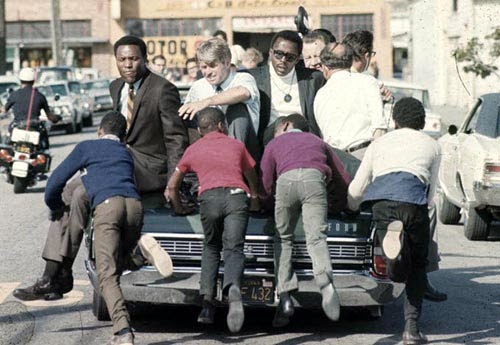
 Bobby Kennedy with crowd during the 1968 Presidential race
Photograph (c) Bill Eppridge/Courtesy Monroe Gallery

 Bobby Kennedy campaigns into the night, 1968
Photograph (c) Bill Eppridge/Courtesy Monroe Gallery

The Kennedy campaign travels through the Watts section of Los Angeles on the last day before the primary, 1968. Photograph (c) Bill Eppridge/Courtesy Monroe Gallery

 Robert Kennedy
Photograph (c) Bill Eppridge/Courtesy Monroe Gallery

Busboy Juan Romero tries to comfort Presidential candidate Bobby Kennedy. The burned master vintage print used for reproduction in LIFE Magazine of Senator Robert F. Kennedy Shot, Ambassador Hotel, Los Angeles, Ca, June 5, 1968. Photograph (c) Bill Eppridge/Courtesy Monroe Gallery
 Read

Photographs by Bill Eppridge, courtesy of the Monroe Gallery, Santa Fe

9.11.2013

GORDON PARKS: The Making of an Argument New Orleans Museum of Art

Gordon Parks, Untitled, Harlem, New York, 1948
Courtesy of The Gordon Parks Foundation


An exhibition that explores Parks' first photographic essay, "Harlem Gang Leader," for Life Magazine in 1948

In 1948, Gordon Parks began a professional relationship with Life magazine that would last twenty-two years. For his first project, he proposed a series of pictures about the gang wars that were then plaguing Harlem, believing that if he could draw attention to the problem then perhaps it would be addressed through social programs or government intervention. As a result of his efforts, Parks gained the trust of one particular group of gang members and their leader, Leonard "Red" Jackson, and produced a series of pictures of them that are artful, emotive, poignant, touching, and sometimes shocking. From this larger body of work, twenty-one pictures were selected for reproduction in a graphic and adventurous layout in Life magazine.

At each step of the selection process – as Parks chose each shot, or as the picture editors at Life re-selected from his selection-any intended narrative was complicated by another curatorial voice.

Curator Russell Lord notes, "By the time the reader opened the pages of Life magazine, the addition of text, and the reader's own biases further rendered the original argument into a fractured, multi-layered affair. The process leads to many questions: 'What was the intended argument?' and 'Whose argument was it?'." Gordon Parks: The Making of an Argument examines these questions through a close study of how Parks' first Life picture essay was conceived, constructed and received.

The exhibition includes vintage photographs, original issues of Life magazine, contact sheets and proof prints all made available by The Gordon Parks Foundation. Additionally, the exhibition is accompanied by a catalog also entitled Gordon Parks: The Making of an Argument by Russell Lord, Freeman Family Curator of Photographs at NOMA, a foreword by Peter W. Kunhardt, Jr., Executive Director of The Gordon Parks Foundation and an afterword by Irvin Mayfield, Artistic Director of the New Orleans Jazz Orchestra. (text courtesy of NOMA)

 September 12, 2013 – January 19, 2014

9.11.2012

GORDON PARKS: Centennial Honoring the Legendary African American Photographer

Untitled, Mobile, Alabama, 1956 
(c) The Gordon Parks Foundation. Courtesy Howard Greenberg Gallery
Ondria Tanner and Her Grandmother Window-shopping, 1956
(c) The Gordon Parks Foundation. Courtesy Howard Greenberg Gallery


The two images above are included in a Limited Edition Portfolio of 12 color photographs taken by Gordon Parks for a 1956 Life Magazine photo-essay, The Restraints: Open and Hidden. The set of twelve 16 x 20" images is printed in a limited edition of twelve numbered sets released in a Portfolio published by the Gordon Parks Foundation, available from the Howard Greenberg Gallery.


Untitled, Shady Grove, Alabama, 1956
(c) The Gordon Parks Foundation. Courtesy Howard Greenberg Gallery

The color photograph, Untitled, Shady Grove, Alabama, 1956, of a family waiting in front of an ice cream shop on a hot summer day, is on view for the first time as part of the "Segregation Story" series taken for Life Magazine.

Muhammad Ali, Miami, Florida, 1966
(c) The Gordon Parks Foundation. Courtesy Howard Greenberg Gallery


Ingrid Bergman at Stromboli, 1949
(c) The Gordon Parks Foundation. Courtesy Howard Greenberg Gallery

"Gordon Parks is the most important black photographer in the History of Photojournalism. Long after the events that he photographed have been forgotten, his images will remain with us, testaments to the genius of his art, transcending time, place and subject matter.”– Harvard Professor Henry Louis Gates, Jr.

Gordon Parks, born into poverty and segregation on a farm in Kansas in 1912, was the youngest of 15 children. He worked at odd jobs before buying a camera at a pawnshop in 1938 and training himself to become a photographer. Parks was a photographer at the Farm Security Administration and later at the Office of War Information in Washington D.C. from 1941 to 1945. As a freelance photographer, his 1948 photo essay on the life of a Harlem gang leader won him widespread acclaim and a position from 1948 to 1972 as the first black staff photographer and writer for Life Magazine, the largest circulation picture publication of its day. He was also a noted composer and author, and in 1969, became the first African American to write and direct a Hollywood feature film, The Learning Tree, based on his bestselling novel of the same name. This was followed in 1971 by the hugely successful motion picture, Shaft. Parks was the recipient of numerous awards, including the National Medal of Arts in 1988 and over 50 honorary doctorates. Parks died in 2006 at the age of 93.

In honor of the 100th Anniversary of the birth of Gordon Parks, the Howard Greenberg Gallery in collaboration with the Gordon Parks Foundation will present two simultaneous exhibitions of his work. Contact: Gordon Parks, Ralph Ellison, and “Invisible Man” curated by Glenn Ligon and Gordon Parks: Centennial, which includes nearly 40 works spanning five decades of the artist’s career beginning in the early 1940s, including some of the legendary photographer’s most seminal images. Most noteworthy in the exhibitions will be a number of color prints from Segregation Story, 1956.

The exhibitions will coincide with Gordon Parks Collected Works, a five-volume book on his photographs. (Steidl, 2012). The book will be the most extensive publication to document Gordon Parks’s legendary career.


Untitled, 1950
(c) The Gordon Parks Foundation, courtesy Howard Greenberg Gallery
Paris Fashions, Countess Maxine de la Falaise, 1950
(c) The Gordon Parks Foundation, courtesy Howard Greenberg Gallery

The Gordon Parks Foundation permanently preserves the work of Gordon Parks, makes it available to the public through exhibitions, books, and electronic media, and supports artistic and educational activities that advance what Gordon described as "the common search for a better life and a better world." The Foundation is a division of the Meserve-Kunhardt Foundation.

A number of other exhibitions in New York will coincide with the exhibition at Howard Greenberg Gallery including Gordon Parks: 100 Years at the International Center for Photography through January 6, 2013; Gordon Parks: 100 Moments at the Schomburg Center for Research in Black Culture through December 1, 2012; Gordon Parks: Crossroads at the Tisch School of the Arts, Gulf+Western Gallery, from September 4 through September 25, 2012; and Gordon Parks: A Harlem Family 1967 at the Studio Museum of Harlem from November 7, 2012 through February 2013.

Many thanks to the Howard Greenberg Gallery for images and text above; and to Diana Revson, Director of External Affairs for The Gordon Parks Foundation, for keeping me informed over the years of the Foundations artistic and educational activities that advance what Gordon Parks described as "the common search for a better life and a better world." –EA

5.30.2012

LAWRENCE SCHILLER: Talks Marilyn Monroe at Steven Kasher Gallery

Larry Schiller and Steven Kasher, May 2012
Photo © Elizabeth Paul Avedon

Lawrence Schiller and Marilyn Monroe on the set of her unfinished last film "Something's Got to Give, 1962."©Lawrence Schiller/Courtesy TASCHEN... La Lettre de la Photographie 5.30.2012


Schiller on Meeting Marilyn Monroe for the first time: "Here I am a 23-year-old kid out of college becoming a photojournalist and I was scared shitless...I had seen her on the cover of Time Magazine when I was in college. I had already photographed some celebrities for Life Magazine, but I ‘d never photographed somebody who had been photographed by every photographer in the world. By the time I was introduced to her in 1960, she had been photographed by Alfred Eisenstaedt, Milton Greene, Philippe Halsman, Richard Avedon, you just name it..."


“Oh you’ll never get a good picture from that angle. Go over there where the light will be better and I’ll show you what a good picture is.” Then she turns and that’s that...

On his iconic photograph of Marilyn on the cover of his new book, Marilyn & Me: "I think there are probably some unedited Marilyn somewhere. In the new book, there are at least thirty images that came from the shooting for Look Magazine. I’m not exaggerating, until last year I had never looked at that shooting since the day the film was sent into Look Magazine and Marilyn approved the contact sheets...Now I look at it and I come up with this image, the first picture I ever shot of her. This picture was never published; it’s on the cover of the Talese book. It comes from a contact sheet she killed all except the one frame. She said to me as I’m shooting, “Oh you’ll never get a good picture from that angle. Go over there where the light will be better and I’ll show you what a good picture is." Then she turns and that’s that..." –La Lettre de la Photographie link to Interview


6.08.2011

LIFE MAGAZINE: 2011 PhotoBlog Winners

Congratulations to Jean Jacques Naudet,
Alex Kummerman, Magnus Naddermier, Sophie Hedtmann,
and all the Correspondents for La Lettre de la Photographie!


...and to Rob Haggert at APhotoEditor.com,
James Estrin & Josh Haner for NY Times Lens Blog

LIFE 2011 Photo Blog Winners

6.15.2010

ANDY LEVIN: Catastrophe in the Gulf

Photograph (c) Andy Levin/All Rights Reserved

Photograph (c) Andy Levin/All Rights Reserved

Photograph (c) Andy Levin/All Rights Reserved

Photograph (c) Andy Levin/All Rights Reserved

Catastrophe in the Gulf: The Hot Zone
Photographs by Andy Levin

A former Contributing Photographer with Life Magazine, Andy Levin began his career as a staff photographer for the Black Star agency in 1985, where he completed contract assignments for magazines including National Geographic, Time, Newsweek, and Fortune. In 1983 Levin’s photo essay for Life won first place in the prestigious National Press Photographers Association Contest. His personal black and white work on Coney Island has been published in both Reportage and Graphis as well as both Life and Popular Photography. A participant in over fifteen Day in the Life book projects, A Day in the Life of America brought him to New Orleans where he photographed the Charity Hospital Emergency Room. In 2004 Levin moved to Big Easy to document and participate its rich culture.

Just a year later the city was decimated by Hurricane Katrina which Levin photographed while helping his neighbors to safety. Levin’s post Katrina work has been published in the New York Times, Newsweek, US News, GQ, Rolling Stone, USN&WR and People Magazines and Time Magazine. In 2007 he was a finalist for the Eugene Smith Grant for a project entitled “World By the Water” documenting areas of the world that are on the front-lines of global climactic change. – Lightstalkers