Showing posts with label Mongolia. Show all posts

7.15.2014

RICHARD GERE: Pilgrim

 Giza, 2005
Courtesy of the Gere Foundation
Photograph (c) Richard Gere  

EA: Your photograph of the Pyramids and the South Pole (not shown) are like two jewels. I’ve never seen a photograph of the Pyramids from that angle before.

Richard Gere: I was in Cairo in 2005 on the way to the Middle East to meet His Holiness in Jordan, in the ancient stone-carved city of Petra. Elie Wiesel co-hosted “The Petra Conferences” with King Abdullah II of Jordan. They brought together Nobel Prize winners with distinguished social and political leaders. His Holiness was there and I was invited to come, but on the way there I was speaking at a conference of Arab women, "Women, Creativity, and Dissidence" in Cairo, Egypt, under the aegis of the Arab Women Solidarity Association (AWSA). I was there for a couple of days and I befriended one of the key archeologists.

I asked to get to the Pyramids early in the morning. I got there in the morning at dark and waited for the light to come up. We were way out in the desert. I took a lot of pictures. Somehow it was out and around, way on another side, and I could see the Pyramids were almost lining up. When the light was coming up, all the lines were converging and I just had to move maybe ten or twenty yards over, then all the lines created these planes. I’d never seen that angle in a photograph before either.

Richard Gere is represented by the Fahey/Klein Gallery, L.A.

Richard Gere, 108 Stupas
Erdene Zuu, Karakorum, Mongolia, 1995
  Photograph (c) Elizabeth Paul Avedon

 Richard Gere and Khyongla Rato Rinpoche, Bodh Gaya, India 1987 
Photograph (c) Elizabeth Paul Avedon
AMERICAN PHOTO MAGAZINE


As I've lost most of the negatives from the photographs above and on the Gere Foundation site, click through for a last look before they disappear completely! – E.A.

A pilgrim is defined as a person who travels on long journeys. Richard Gere’s book of photographs, Pilgrim (published by Bulfinch Press, ISBN: 978-0821223222), is available from Amazon.com. All proceeds are donated to the Gere Foundation that supports humanitarian causes throughout the world. 

5.14.2013

JOHN DELANEY: Kazakh Golden Eagle Nomads at Photo-Eye Gallery, Santa Fe

Eagle Hunter #9, 2008 
Gelatin-Silver print. Photograph © John Delaney

Silent Watcher, 1998
 Gelatin-Silver print. Photograph © John Delaney

 The Three Horsemen, 1998
Gelatin-Silver print. Photograph © John Delaney

 John Delaney in his traveling Studio

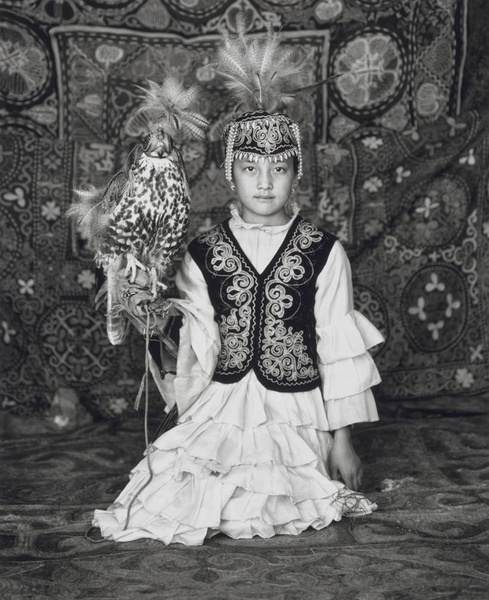
The method and style of my photography is very traditional. I travel with a large format wood view camera and a portable studio tent. My traveling studio not only controls the light but also serves as a common meeting ground in which my subjects present themselves. The goal is to create a portrait that reveals something beneath the obvious: a sense of grace, nobility, or humanity. – John Delaney

Nomad Girl w/ Falcon, 2008   
Gelatin-Silver print. Photograph © John Delaney

"Every year soon after the first snowfall these majestic men will mount their horses and head up into the mountains in search of prey. They will lose their eagles on any unsuspecting fox, rabbit, and even wolf. The Kazakhs capture their eagles while young, often directly from their  cliff side nests. They take only the female, which are larger and more aggressive than the male. The eagles stay with the hunter for about seven years, during which time man and bird live in symbiosis, bound in survival. With a wingspan of over 7 feet and talons that can easily crush bone, these majestic predators make formidable allies. In the more isolated valleys of the Altai Mountains this hunt still provides needed food and furs for harsh winters. And it has become a treasured tradition and right of passage for the Kazakh men."– John Delaney

Shot in Mongolia in 2008, John Delaney's Golden Eagle Nomads centers on the relationships between the nomadic Kazakh people and their golden eagle hunting companions. Though their nomadic lifestyle and hunting traditions date back to the 5th Century (and possibly earlier), the Kazakh's way of life is now threatened by an encroaching Western influence and globalization. Delaney's photographs capture the unique and complex symbiotic relationship between the Kazakh people and these powerful birds. Delaney was honored with the 2008 Lucie/International Photography Awards 'Discovery of the Year' for this series and was Master Printer for Richard Avedon, Irving Penn, Bruce Davidson, Patrick Demarchelier, Steven Klein, among others. His work has been exhibited both nationally and internationally.


Exhibition: May 17 – July 12
Artist Reception: June 5,  5‐7 pm 
Artist Talk: June 5, 6 pm 

376 Garcia Street Santa Fe, NM

4.30.2011

RICHARD GERE: Talks About Photography in La Lettre de la Photographie's Weekend Agenda

Giza, 2005
Courtesy of the Gere Foundation
Photograph (c) Richard Gere

Cairo, 2010
Courtesy of the Gere Foundation
Photograph (c) Richard Gere

I was in this old Mosque and I just turned to my left and that shot was there. All the angles were right, all the lines were moving, everything was right. All I had to do was take a half step to my left. Everything lined up and I knew that was it. That was the shot...That’s a very complicated photograph; the dark areas, light areas, white against black, black against white. It’s very complicated and that’s a very straight...digital print made for me by John Paul Caponigro at his place up in Maine. – Richard Gere, Le Journal de la Photographie 4.30.2011

Cover Photograph: Pilgrim, Zansker, 1983
Pilgrim, Bulfinch Press, 1997

Richard’s photographs from “Pilgrim” are clearly made from the heart. They are not only pictures that you are informed by – but they are images you feel. Richard’s images speak to our soul by exuding spirituality, compassion, and atmosphere. Richard’s “Pilgrim” photographs formed by his experiences, defines what he represents, and documents his social, spiritual, and cultural encounters. The underlining thread of his photographs is his fondness for the people of Tibet as well as his extraordinary ability to document the livelihood of the enduring people who reside within these unfamiliar and mysterious places with dignified simplicity. – David Fahey, Fahey/Klein Gallery

Lobsang Tenzing, Daramsala, 1981
Photograph © Richard Gere, Courtesy of Fahey/Klein Gallery, Los Angeles

Ulan Bator (The Arrival of His Holiness), Mongolia, 1995
Photograph © Richard Gere, Courtesy of Fahey/Klein Gallery, Los Angeles

Angels, Shekar Monastery, Tibet, 1993
Photograph © Richard Gere, Courtesy of Fahey/Klein Gallery, Los Angeles

There are usually three shots. If it’s a difficult light situation like this where the shutters going to be open one, two, three seconds – from my own experience of my work, one of those three is going to be the one I want. It’s not always that one is sharper than another; whatever it is, one’s going to feel right to me if I do three of them. Sometimes it’s so dark, I can’t even see it, and I’m just sensing that there’s something there. There’s one in particular I took in a Monastery. It’s these two angels that are hovering there. (Angels, Shekar Monastery, Tibet, 1993) I could barely see anything when I took that shot, but I knew that the shot was there and I knew I had to take it “now.” Richard Gere, Le Journal de la Photographie 4.30.2011


Photography can open a doorway that can lead us into a new world, expands our horizons, and shows us exciting and challenging possibilities. Richard’s photographs allow us to engage the world and renew our perspective by reinterpreting what we think we know – leading us through that doorway. – David Fahey, Fahey/Klein Gallery

+ + +

I spoke with Richard Gere for Le Journal de la Photographie about his photographs, his book and exhibitions, and about his extensive photography collection...read the entire Interview here

Le Journal de la Photographie

12.13.2009

RICHARD GERE: Pilgrim

Pilgrim, Zanskar, 1983 • Fahey/Klein Gallery
Photograph (c) Richard Gere /All Rights Reserved

Mongolian Warrior, Mongolia 1995 • Fahey/Klein Gallery
Photograph (c) Richard Gere /All Rights Reserved

The alchemy of photography is mysterious and unstable...it's component parts of grain shift like smoke in the wind and somehow emerge as an image with only an illusion of beingness – Richard Gere

Richard Gere at Erdene Zuu, Karakorum, Mongolia, 1995
Photograph (c) Elizabeth Paul Avedon