Showing posts with label James Estrin. Show all posts

5.01.2015

SCHOOL OF VISUAL ARTS: Fall 2015 MPS in Digital Photography Program

Clay McBride

Large Format Print Week with
Celebrity and Portrait Photographer Greg Gorman

Clareese Hill

Ksenia Tavrina

Photography Icon Bruce Davidson Lecture

Tom Ashe Reviewing Online Class Prints

The School of Visual Arts
Master of Professional Studies in Digital Photography Program

The Master of Professional Studies in Digital Photography is an intensive graduate degree program that addresses the technical and creative aspects of current digital image practices, which professional photographers and photo educators require to be at the vanguard of contemporary fine art, commercial, portrait, and fashion photography practices. Within the year, the diverse and talented students excel at producing technically outstanding and conceptually compelling images and multimedia projects, and are ideally positioned to pursue gallery representation, editorial or commercial work, as well as high-end digital retouching and consulting careers.

SVA offers two versions of the MPS Digital Photography Program; a full-time one-year On-campus/Summer Residency program for students that prefer learning in a classroom environment and a part-time two-year Online/Summer Residency for those who would benefit from the convenience and flexibility of the virtual learning experience. Both programs culminate with a summer session and group exhibition in New York City.

MPS Digital Photography Program Co-Founder and Chair, Katrin Eismann, is an internationally respected photographer, educator and author specializing in creative digital photography. Her books include Photoshop Masking and Compositing, Photoshop Restoration and Retouching, The Creative Digital Darkroom, and Real World Digital Photography, among others.

Applications for Fall 2015 MPS Digital Photography Program are being accepted now! Study with Elizabeth Avedon, Michael Foley, Greg Gorman, James Estrin, Tom P. Ashe, Darren and Debra Klomp Ching, Russell Hart, Stella Kramer, Matthew Richmond and Katrin Eismann, along with a roster of other greats! Check out the complete MPS Digital Photography Curriculum and Faculty [here].


Check out my Thesis: Book+Branding Class of 2014

Thesis: Book+Branding Class of 2013 

4.25.2015

THE NEW YORK TIMES LENS PORTFOLIO REVIEWS: Day 1 + 2


I was honored to be invited as a Reviewer for the third annual "New York Portfolio Review" sponsored by the New York Times Lens Blog and the City University of New York’s (CUNY) Graduate School of Journalism. The reviews took place over a recent weekend with Day One for photographers 21 and older, each of whom received six private critiques; Day Two for photographers 18 to 27 years old, with four private critiques for each participant, rounded out with talks by Santiago Lyon, director of photography for The Associated Press, on building an editorial portfolio, and by the photographer Phil Toledano on the creative process. There were several other great speakers during the day including collector WM. Hunt, photographers David Guttenfelder, Radcliffe 'Ruddy' Roye and Austin Merril of Everyday Africa, who joined New York Times Lens Blog co-editor, James Estrin and Kerri MacDonald for a very lively panel discussion.

Of the twelve photographers I was scheduled to review on Day One, and a few I met on my own time during breaks, I was impressed by every project shown and
want to share some of it with L'Oeil de la Photographie readers HERE.


James Estrin took the lead along with his Lens Blog colleagues David Gonzalez and Whitney Richardson, and Laura Roumanos of United Photo Industries and Photoville, screening and editing thousands of (free) entries down to the chosen photographers who were then assigned one-on-one portfolio reviews with some of the top photography editors, curators, gallerists and book publishers. Estrin noted, "We have looked through over 3500 entrants for the free NY portfolio review sponsored by the NY Times Lens blog and CUNY J School and whittled it down to those accepted. The amount of excellent work was overwhelming...I can firmly say there is wonderful and surprising photography being done all over the world by people of all age, race, ethnicity, gender and sexual orientation. I apologize to those who didn't get accepted this year. Thank you for sharing your work. It was an honor to look at it so closely. Please try again next year." Both days were extremely successful with reviewers and photographers making beneficial connections.

On Day Two, of the eight reviews, most were recent student graduates and this was their first portfolio review. I was impressed by the level of work and want to share some of it with L'Oeil de la Photographie readers HERE.

6.04.2014

JAMES ESTRIN: Oprah's Super-Soul Sunday TV

On Oprah's OWN TV

“Silence and Dust, 9/11 Memorial, 2002” On the first Anniversary of the World Trade Center attacks, rescue workers formed a circle on Ground Zero for a minute of silence. At that moment, a strong wind blew dust around the circle. © James Estrin/The New York Times

A must-see video of award-winning photographer James Estrin talking about his Spiritual Experiences and Photography, is introduced by Oprah herself!  Tune in Sundays at 11 a.m ET/PT for Oprah's Super Soul Shorts on OWN Network.

"James Estrins' sensitivity and technical skill combine to create impactful moments in the world he observes..." When thousands of people gathered to commemorate the first anniversary of 9/11, Estrin was assigned one of the least accessible vantage points, yet his extraordinary photograph, “Silence and Dust, 9/11 Memorial, 2002”, was the most powerful (and chilling) image made of the event." Read more from my Interview With James Estrin on L'Oeil de la Photography

1.08.2014

JAMES ESTRIN: Elizabeth Avedon Interview

Trance dancing at a Trinidadian Hindu temple devoted to the goddess Kali in Queens. 2005 © James Estrin/The New York Times

Sheikh Reda Shata, an imam, blesses a newborn child at a Hospital in Brooklyn. 2005 © James Estrin/The New York Times

A ceremony for the dead at a Cambodian Buddhist temple in the Bronx. 2005 © James Estrin/The New York Times

“Silence and Dust, 9/11 Memorial, 2002.” Rescue workers formed a circle on ground zero for a minute of silence in observance of the anniversary of the World Trade Center attacks. A strong wind blew dust around the circle. © James Estrin/The New York Times

James Estrin Talks To Elizabeth Avedon

In James Estrin’s exhibition "Observance: Photographs of Spiritual Experience" opening today, sensitivity and technical skill combine to create impactful moments in the world he observes. When thousands of people gathered to commemorate the first anniversary of 9/11, he was assigned one of the least accessible vantage points, yet his extraordinary photograph, “Silence and Dust, 9/11 Memorial, 2002”, was the most powerful (and chilling) image made of the event.

Estrin, a senior staff photographer for the New York Times and founder and co-editor of Lens, the Times's photography blog; is also a writer for the Times and produces audio and video for nytimes.com. He was part of the team that won a Pulitzer Prize in 2001 for the series “How Race is Lived in America.” Internationally, he has covered the Israeli-Palestinian conflict, photographed the devastation in Haiti following the earthquake, and in 2004, was the first journalist to document an assisted suicide in Oregon.

I had the opportunity to talk with James before the opening of his exhibition:

Elizabeth Avedon: How old were you when you first became interested in photography?
 

James Estrin: I was 16, and I knew pretty quickly that I wanted to be a photographer.

EA: What direction would you have gone in if you had not become a photojournalist?
 
James Estrin: Good question. It’s not that I had many skills when I was 22.  I think I would have become a teacher.

EA: You've been a New York Times photographer for over two decades. How did you get to this point in time?

James Estrin: I've been with the New York Times for 26 years; I was a freelancer for the first four years. I'm now a senior staff photographer, and for the last four and a half years I've been the co-editor of the Lens Blog. At first David Dunlap and Josh Haner were co editors and for the last 2 years David Gonzalez has been the Lens co-editor. And there’s our producer Matt McCann who is indispensable.

I went to Hampshire College and the International Center of Photography in the Advanced Studies program. But I thought I should give myself a chance to do something else. I studied some photography at college with Jerry Liebling but mostly I studied anthropology and history.

I'm a big proponent of studying as many things as you can. I think you shouldn’t only study photography or journalism.  That is like majoring in wood shop.

Much of photography is a craft, and what separates one photographer from another besides a visual style is what you have to say. To have something to say, you have to have ideas and thoughts. I think every photographer should know art history; every photographer should have a good grounding in literature, philosophy, anthropology and history.

When I left ICP I took a job in Jackson, Mississippi at the Clarion-Ledger, which was a very good paper at that time.  After two years I went to Washington, D.C. to freelance and then to New York where I was a stringer or temporary staff for every paper in NY- Newsday, the Post, the Daily News and finally for the Times for four years. I got hired at the Times January 13th, 1992.

EA: What have been your most challenging assignments?
 
James Estrin: Among them have been covering the attacks on the World Trade Center and the incursions in Ramallah by Israel in 2002. The story that I did on the making of an American Imam in Brooklyn in 2006 was also quite challenging. And it took me years to arrange to photograph an assisted suicide in Oregon in 2004.

EA: What effect did the experience of the assisted suicide have on you or your work?

James Estrin: It was very difficult to gain people’s trust, get access to people considering employing the suicide law there and attend an actual suicide. It reaffirmed my belief that if you are honest and open with people – and patient-that you can photograph anything.

It had more of a personal effect then a professional one. It was a very profound experience. It makes me constantly evaluate where I find meaning in life. I did a multi media piece on this. It was 2004 and I didn’t really know what I was doing but the power of the story comes through anyway.

Link:http://www.nytimes.com/packages/khtml/2004/05/31/science/20040601_RIGHT_FEATURE.html

EA: At what point did you begin to incorporate writing with your stories?

James Estrin: I think it was 2003. I always came up with story ideas but had to get a writer to suggest them to word editors to get them done. Of course the Times has many excellent reporters so that usually worked out well. But even when it did, I wasn’t the primary storyteller. I was illustrating someone else’s words. And on occasion their take on the story was somewhat different than mine.

After one experience that didn’t work out so well I decided that I should try it. And I did. For the next few years I wrote a couple of stories a year, and then we started Lens and I dove into the deep end.

EA: Let's talk about your exhibition "Observance: Photographs of Spiritual Experience." What was the original force behind creating this work?
 

James Estrin: I have always been interested in spiritual experience - both photographically and personally. From an early age I thought there was more to life than immediately met the eye.

That’s the challenge for me in these photos. Religious ritual is visually lush and made for photographers. Actual spiritual experience is internal and essentially not visible.

EA: Your photograph "Silence and Dust, 9/11 Memorial, 2002" is a transcendent image for me. How did it occur? 

James Estrin: This was a ceremony at Ground Zero one year after 9/11. I was on the 8th floor terrace across the street about as far as could be from what I thought was a good position. I wanted to be down on the ground near the ceremony but I was assigned to the roof. I couldn’t move. I had several very long lenses with me.

At one point something happened in the corner of the site, someone about to walk down the ramp, perhaps the president or the mayor. And photographers started looking that way.

I'm looking the other way and this wind blows and brings up this dust - and its quite remarkable, it feels like the place is alive.

Exhibition
Observance: Photographs of Spiritual Experience by James Estrin
From January 7 to March 3, 2014
92nd Street Y
1395 Lexington Avenue, New York, NY 

BECOME A MEMBER AND FRIEND OF L'OEIL

11.17.2012

SVA PHOTOGRAPHY: Student Images | Part I Documentaries

Photograph © Xizi Wang
 
Photograph © Xizi Wang

 LAW OFFICER vs. THAI RESTAURANT, BEIJING
by Xizi Wang
"These photographs were taken when I interned for a Beijing newspaper. The case was about a Thai restaurant arrears for the cook's salaries for almost for two years, and the law officers who had the authorization to enforce closing this restaurant’s office. In the photograph at top, the law officer showed the Thai restaurant manager the enforcement order to close and she reacted really aggressively. In the second image, the Thai restaurant manager is surrounded by photographers from different newspapers and local TV stations."


Photograph © Zoha Babazadeh 
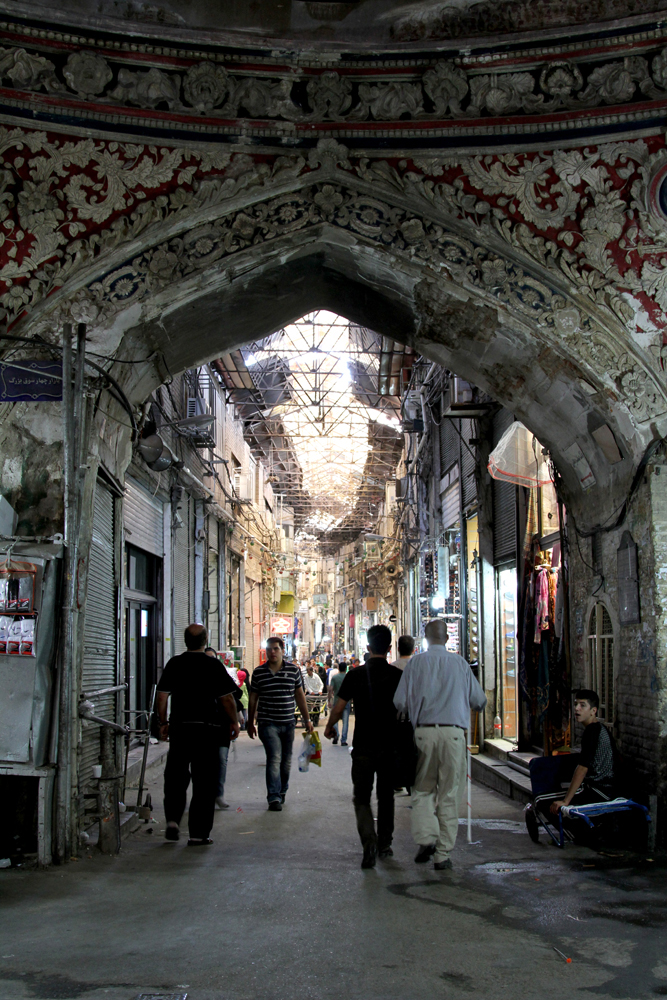
An ancient gateway into the Grand Bazaar

Photograph © Zoha Babazadeh

 THE GRAND BAZAAR, TEHRAN
by Zoha Babazadeh
"The Grand Bazaar is a historical market situated in the capital of Iran, Tehran. Throughout history, the Grand Bazaar has played host to banks and financiers, mosques and guest houses. Traditionally, the Tehran bazaar was split into corridors, each specializing in different types of goods, including copper, carpets, paper, spices, as well as traders selling all types of goods."
 
V I E W  V I M E O

NEW YORK COMIC CON by Mary Wienckowski
 
"I have been going to comic, anime and video game conventions since I was fifteen. Since then it became as integral to my annual schedule as any other major holiday. But like anything that becomes condemned to routine, there is a risk of something once considered wondrous becoming monotonous." Vimeo link

V I E W  F I L M


"Behind the scenes of three of my recent shoots of models posing with movement. I’ve had a special connection to these models from both the aesthetic of their look and the way we work together. With the use of video, the audience is brought into an experience that goes beyond the still photograph." Vimeo link
+  +  +

Inspired by a talk given to my sophomore BFA Photography students at the School of Visual Arts by James Estrin, Co-Editor of the NY Times Lens Blog, I gave an assignment to create a documentary or editorial blogpost through slides or video. Above, Part I,  is an excerpt of the excellent work the students turned in after Hurricane Sandy. 


Part II [LINK here], is an excerpt of the work of the students who focused on Hurricane Sandy. We knew a storm was heading towards New York, but no one had any idea Hurricane Sandy would black-out downtown Manhattan where many of the students dorms are located and schools would be closed for a couple of weeks.