6.30.2010

SUZANNE PAUL: Portraits and Prominent Figures in the Early Houston Art World

Photograph (c) The Estate of Suzanne Paul/All Rights Reserved

Clair With Fly 1976
from "Women See Women: A Photographic Anthology"
Photograph (c) The Estate of Suzanne Paul/All Rights Reserved

Artist Sculptor Richard Stout 1999
Photograph (c) The Estate of Suzanne Paul/All Rights Reserved

Artist Mel Chin 2000
Photograph (c) The Estate of Suzanne Paul/All Rights Reserved

Exhibition Catalog FotoFest 2001
With an Essay by Exhibition Curator Clint Willour and Walter Hopps
Photograph of Edward Albee by Suzanne Paul


Women See Women: A Photographic Anthology
Includes photographs by Suzanne Paul and also by Anne Wilkes Tucker, now Curator of Photography, Museum of Fine Arts Houston

Self Portrait with Bob
Postcard from Central America 1971
Photograph (c) Suzanne Paul/All Rights Reserved


Mercedes and Bob, Houston 1973
Photograph (c) Suzanne Paul/All Rights Reserved

Elizabeth Paul, Candy Frasier and Marilyn Schiller (Mayo), Houston 1971
"This is a small test print...thought you might be interested, love Suzie"
Photograph (c) Suzanne Paul/All Rights Reserved

"There is a belief in many cultures that the camera is capable of stealing the human soul or spirit. Suzy Paul's camera may not steal the soul, but it certainly captures it and the spirit within."–Clint Willour

Being Human: Portraits by Suzanne Paul
September 6 - October 13, 2001
Curated by Clint Willour
Executive Director and Curator, Galveston Arts Center

Houston, TX (August 20, 2001)- Fotofest began its 2001-2002 exhibition programs at Vine Street Studios with Being Human, an exhibition featuring over 60 black and white portraits taken over a period of more than 40 years by Suzanne Paul. In intimate and revealing ways, Paul documented many of the artists, curators, and gallery owners who shaped Houston's art scene since the 1970's and 80's. (Houston's Fotofest)

+ + +

"The late Suzanne deYoung Paul (b. 1945 - d. 2005), a pioneer female photographer in Houston, was best known for her intuitive portraits of the art world. Being the first female photographer to have a solo exhibition at the Contemporary Arts Museum Houston, and many other prestigious exhibitions including The Fort Worth Art Museum, Galveston Arts Center, private galleries and museums, Paul became known for her portraits of such well known artists as Julian Schnabel, Mel Chin, Andy Warhol and playwright Edward Albee. Several of her photographs are in the Collection of the Museum of Fine Arts, Houston.

The late Walter Hopps said of Suzanne Paul, "[She] should be recognized as one of the finest photographers to come out of Houston. Her essential medium is black and white photography, and her most important subject matter is portraiture. Not all photographers are skilled printers of their work. Paul is a superb printer achieving areas of deep black in line with her instinct for the chiaroscuro lighting of the subject. Having been the subject of one of Paul's portraits, I have experienced the directness and honesty of her work. She has caught an unidealized view of who I am." (Deborah Colton Gallery)

At the age of nine, Paul began photographing her sister, dogs, and horses with a Kodak Brownie camera given to her by her father, also a photographer. She studied Fine Arts at the University of Houston graduating with a BFA in 1963 and later did graduate work at the University of California at Berkley in 1970. She considered herself to be a self-taught photographer, however, because classes in photography were not available at that time. Early on she saw an Irving Penn photograph which sparked her interest in photography. She credits Diane Arbus with inspiring her to search for "that most revealing moment" in portraiture. Her start in the art world came in 1976 when Contemporary Art Museum Director Jim Harithas hired her to document artists and exhibits for the museum's catalogs.

Paul used a 1957 Rolleiflex camera, drove a 1960 Oldsmobile, and may have been one of the few artists in Houston without an e-mail address. Following in the tradition of Imogene Cunningham, Paul photographed with the twin lens reflex camera as well as a Holga camera with a plastic lens. She began shooting with 35mm but eventually felt the need to move to the larger 2 1/4 medium format negative and continued to do all her own printing. As stated by her daughter Mercedes Paul, "Suzanne's ability to capture the true essence and spirit within the souls of her subjects proved that she could identify with people from all walks of life. She worked on a higher, more intuitive level than most humans experience."

Suzanne Paul's photographs are represented by
Deborah Colton Gallery
, Houston

+ + +

Clint Willour has curated and juried hundreds of exhibitions all over the world. He visits studios and volunteers his time for myriad committees and boards. Noted for his keen eye and dry sense of humor, Willour is a trusted advisor to all kinds of people in the art world. He's an enthusiastic advocate for emerging artists, giving insightful portfolio reviews everywhere, from FotoFest's biennial "Meeting Place" to the People's Republic of China. Willour, who was named Texas Patron of the Year in 2006 by the Art League Houston, is also an astute collector and generously donates to institutions. Over the years Willour has given more that 1,000 artworks to the Museum of Fine Arts, Houston; they're now valued at $1.2 million. (from Houston Press)

I'd like to personally thank Clint Willour, Executive Director and Curator of the Galveston Arts Center, for his more than generous help. He actually took the time to research SP's work at the Museum of Fine Arts, Houston and send it to me! Thank you so much.

+ + +

Very few images of Suzanne Paul's work are available to view online. I hope this post may inspire a Photography student in Houston to create a project for academic credit to scan Suzanne's photographs. Hopefully many more people will be able to view her work online in the future.
+ + +

Interview about the Houston Center for Photography's founding with Clint Willour and Anne Wilkes Tucker

****
The poor quality of the images is no reflection on Suzanne Paul's work,
but on my poor scanning


6.27.2010

NEW MEXICO: Summer of Photography


Chiaroscuro Gallery, 702 1/2 Canyon Road, Santa Fe to July 3rd
Photograph (c) Renate Aller/All Rights Reserved

Essays by Richard B. Woodward and Petra Roettig. Interview with the artist by Jasmin Seck. "German-born photographer Renate Aller has been photographing the Atlantic Ocean for over a decade from a single point on the fabled Hamptons’ coastline. Her images capture the infinitely shifting colors and textures of the sky and water, and the beauty and grandeur of the ocean, providing a rich document of what has drawn people to this area for generations. The sublime beauty of this view, which Aller directly connects to the great 19th century German Romantic painter Caspar David Friedrich, is also a metaphor for the landscape of the human emotions. Aller’s viewpoint is static, but the changing weather and light allow for a diverse series of images that open up a vast ‘visual library’ of memories and associations. Printed in Germany, the book captures the subtle mystery of her larger prints and the original oceanscapes."

OCEANSCAPES Chiaroscuro Gallery through July 3rd, 2010

+ + +
Richard Levy Gallery, 514 Central Avenue SW, ABQ

from The Shower Series
Photograph (c) Manjari Sharma/All Rights Reserved

Paani / Water in Hindi. Photographs from Manjari Sharma's Water and Shower Series. Sharma imbues her images with an overwhelming sense of calm and beauty throughout these strikingly distinct bodies of work.

PAANI
Photographs by Manjari Sharma
Richard Levy Gallery July 9 - Aug 20, 2010

+ + +
Monroe Gallery, 112 Don Gaspar, Santa Fe July 3-Sept 26
The Kennedy campaign travels through the Watts section of Los Angeles on the last day before the primary, 1968. Photograph (c) Bill Eppridge/All Rights Reserved

The Robert F. Kennedy funeral train travels through Trenton, New Jersey
Photograph (c) Bill Eppridge/All Rights Reserved

Bill Eppridge: An American Treasure
Monroe Gallery July 3 - Sept 26, 2010

"Bill Eppridge is one of the most accomplished photojournalists of the Twentieth Century and has captured some of the most significant moments in American history: he has covered wars, political campaigns, heroin addiction, the arrival of the Beatles in the United States, Vietnam, Woodstock, the summer and winter Olympics, and perhaps the most dramatic moment of his career - the assassination of Senator Robert Kennedy in Los Angeles". View Bill Eppridge post here

+ + +
photo-eye Gallery, 376 Garcia Street, Santa Fe
Photograph (c) Mitch Dobrowner/All Rights Reserved

El Creston. (l)Photograph (c) Edward Ranney. Sunburned GSP#351. (r) Photograph (c) Chris McCaw/All Rights Reserved.

6.24.2010

PHOTO-EYE GALLERY: Mitch Dobrowner, Edward Ranney and Chris McCaw Photographs


MITCH DOBROWNER
Clouds, 2010
Photograph (c) Mitch Dobrowner/All Rights Reserved

Shiprock triptych, 2008
Photograph (c) Mitch Dobrowner/All Rights Reserved

"I get into a ‘zone’ where time and space seem hard for me to measure." Inspired by his love of storms, LA based photographer Mitch Dobrowner set out to track and photograph these breathtakingly beautiful natural phenomena, driving over 5700 miles across ten mid-western states.

EDWARD RANNEY
San Cristobal Pueblo, Galisteo Basin, 2007
Photograph (c) Edward Ranney/All Rights Reserved

El Creston
Photograph (c) Edward Ranney/All Rights Reserved

Landscape photographer Edward Ranney's photographs from his newest monograph Down Country of the historically rich Galisteo Basin will be on exhibit. Down Country is the history of five centuries of the Southern Tewa Pueblo Indian culture that rose, faltered, reasserted itself, and ultimately perished in the Galisteo Basin. Down Country Book Signing July 16th 5-7

CHRIS McCAW
Sunburned GSP#281 (Pacific Ocean), 2008
Photograph (c) Chris McCaw/All Rights Reserved

Sunburned GSP#279 (Pacific Ocean/movement), 2008
Photograph (c) Chris McCaw/All Rights Reserved

This project has got my mind working overtime and has rejuvenated my faith in analog photography. My favorite part is watching smoke come out of the camera during the exposure!

San Francisco based photographer Chris McCaw began experimenting with burning film by means of long exposures and the sun. Through trial and error, he began using vintage fiber-based gelatin-silver black-and-white photographic paper, putting it in the film holder in place of film and creating a unique paper negative print. In long exposures the sun actually burns through the paper, creating this unique body of work.

+ + +
July 10-Sept 5, 2010
PHOTO-EYE GALLERY SUMMER EXHIBITION
photo-eye Gallery will be exhibiting a selection of photographs from Mitch Dobrowner, Edward Ranney and Chris McCaw
+ + +

6.22.2010

OSKAR BARNACK: Revolutionized Photography

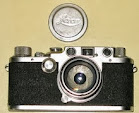
Oskar Barnack's Ur-Leica
"The small format 35mm camera created a revolution in photography"

Hohenzollernbrücke, Cologne
Photograph (c)
Oskar Barnack


Eselstreppchen, 1914
Photograph (c)
Oskar Barnack


Flood, Langgasse, 1920
Photograph (c)
Oskar Barnack


Eisenmarkt
Photograph (c)
Oskar Barnack


Self Portrait, 1914
Photograph (c)
Oskar Barnack


"Oskar Barnack's genius idea of creating the small format 35mm camera created a revolution in photography"

Oskar Barnack wanted to move away from the traditional, heavy plate cameras then used for most photography. As early as 1905, he had the idea of reducing the negative format and enlarging the photographs at a later stage. Ten years later Barnack developed the Ur-Leica, the first successful small-format camera. The photographs created in 1914 were of outstanding quality for the time. Delayed due to World War I the first LEICA did not enter series production until 1924 and introduced to the public in 1925.(more about the history of the Leica here).

Many thanks to
New York Leica Gallery Director's, Rose A. Deutsch and Jay R. Deutsch, for introducing me to the Leica creator. Oskar Barnack Room, Leica Gallery, NY

6.21.2010

INEZ VAN LAMSWEERDE & VINOODH MATADIN: FOAM Fotografiemuseum


Me Kissing Vinoodh (Passionately), 1999
Photograph
©Inez van Lamsweerde and Vinoodh Matadin/All rights reserved

Bjork (Poisson-Nageur)
Photograph
©Inez van Lamsweerde and Vinoodh Matadin/All rights reserved

Clint Eastwood – The New York Times Magazine, 2005
Photograph©Inez van Lamsweerde and Vinoodh Matadin/All rights reserved

PRETTY MUCH EVERYTHING: PHOTOGRAPHS 1985-2010
FOAM FOTOGRAFIEMUSEUM AMSTERDAM
June 25-Sept 15, 2010

"Dubiousness is at the base of practically every image they make. Their work is ambiguous in every sense of the word and balances deliberately on the thin rope between fashion and art, perverting both worlds, mirroring the strangeness of everyday life through an extreme enlargement of a singular part."

Amsterdam's Foam FotografieMuseum exhibition, Pretty Much Everything, spans 25 years of work of the world famous photographic duo, Inez van Lamsweerde and Vinoodh Matadin. Inez and Vinoodh began their work together in 1986 in Amsterdam. Now, 25 years later, with their campaigns for fashion houses such as YSL, Chanel, Balmain, Gucci, Louis Vuitton and Chloe, and with regular publications in W Magazine, Vogue and The New York Times, they are among the few artists that have successfully crossed the line drawn between fashion and art and have managed to simultaneously maintain careers in both fields. Art, fashion and portrait works all exist next to each other in the exhibition. By disregarding any chronological order the combination of images are based on personal, formal, social, political and intuitive associations that show the way the artists have lived with the images for 25 years. Anthology Pretty Much Everything (Steidl)

6.18.2010

BILL EPPRIDGE: Kennedy Campaign Trail

Bobby Kennedy campaigns into the night, 1968
Photograph (c) Bill Eppridge/All Rights Reserved


Bobby Kennedy with crowd during the 1968 Presidential race
Photograph (c) Bill Eppridge/All Rights Reserved

Robert Kennedy, New York City
Photograph (c) Bill Eppridge/All Rights Reserved


Senator Robert Kennedy at a rally, Sioux City, Iowa, 1966
Photograph (c) Bill Eppridge/All Rights Reserved


Busboy Juan Romero tries to comfort Presidential candidate Bobby Kennedy. The burned master vintage print used for reproduction in LIFE Magazine of Senator Robert F. Kennedy Shot, Ambassador Hotel, Los Angeles, Ca, June 5, 1968. Photograph (c) Bill Eppridge/All Rights Reserved

July 2-Sept 26, 2010

"An American Treasure"

Photographs by Bill Eppridge

Monroe Gallery, Santa Fe

6.16.2010

LEICA GALLERY: Oskar Barnack Room

Oskar Barnack invented the Leica in 1925
The Oskar Barnack Room, Leica Gallery, New York

Click images to enlarge
The Oskar Barnack Room. (top left) Breslau, 1942, Photograph by Zdenek Tmej; (bottom left) Sold: Lovers In Smoke, Photograph by Frank Stewart. Three Photographs by Harry Weber (center) Opera Ball, Vienna, 2001 (top right) A Lippizzaner, Spanish Riding School, Vienna, 1958 and (bottom right) Lighting the Sabbath Candles, Vienna, 1995.

Molly, 1993 (top) and Pee Pee Rose Angelina, 1987
Photographs by Robin Schwartz

New York's Leica Gallery Director's, Rose A. Deutsch and Jay R. Deutsch, are celebrating the Leica Gallery going into it's 17th year. The gallery, run in partnership with Leica Camera and closely linked to the company, exhibits both traditional and modern photojournalism. Since its foundation, it's housed more than 115 exhibitions, including work by renowned photographers such as Alfred Eisenstaedt, Ralph Gibson, Leonard Freed, Susan Meiselas, Inge Morath, Alex Webb, Erich Hartmann, Karl Lagerfeld and most recently, Antonin Kratochvil.

Their current exhibition, The Marcus Family: Three Generations of New York's Elite Society and Wedding Photographers, is a joyful show about happy occasions. The Marcus Studio being the Bentley of wedding and party photography, this exhibition of photographs from their archives spans three generations of New York's most notable social events. June 11- August 7

Oskar Barnack Room:
"Oskar Barnack's genius idea of creating the small format 35mm camera created a revolution in photography in 1925, paving the way for the birth of the Leica Legend. His diminutive, lightweight LEICA A offered a new, undreamed-of freedom in reportage and artistic photography. From that point to the present day, Leica has had a profound influence on our view of the world we live in."

Always interesting to visit is the revolving gallery of images for sale in the Leica Galleries Oskar Barnack Room. Most photographs are 11 x 14"or 12 x 16" gelatin silver and signed by the photographer. Images for sale include photographers Oskar Barnack, Leonard Freed, Bohdan Holomicek, Inge Morath, Susan Meiselas, Jan Reich, and Evelyn Richter.

The Leica Gallery is located in an historic building in Greenwich Village that is listed in the records of the American Institute of Architects. 670 Broadway, Suite 500, New York, NY

6.15.2010

ANDY LEVIN: Catastrophe in the Gulf

Photograph (c) Andy Levin/All Rights Reserved

Photograph (c) Andy Levin/All Rights Reserved

Photograph (c) Andy Levin/All Rights Reserved

Photograph (c) Andy Levin/All Rights Reserved

Catastrophe in the Gulf: The Hot Zone
Photographs by Andy Levin

A former Contributing Photographer with Life Magazine, Andy Levin began his career as a staff photographer for the Black Star agency in 1985, where he completed contract assignments for magazines including National Geographic, Time, Newsweek, and Fortune. In 1983 Levin’s photo essay for Life won first place in the prestigious National Press Photographers Association Contest. His personal black and white work on Coney Island has been published in both Reportage and Graphis as well as both Life and Popular Photography. A participant in over fifteen Day in the Life book projects, A Day in the Life of America brought him to New Orleans where he photographed the Charity Hospital Emergency Room. In 2004 Levin moved to Big Easy to document and participate its rich culture.

Just a year later the city was decimated by Hurricane Katrina which Levin photographed while helping his neighbors to safety. Levin’s post Katrina work has been published in the New York Times, Newsweek, US News, GQ, Rolling Stone, USN&WR and People Magazines and Time Magazine. In 2007 he was a finalist for the Eugene Smith Grant for a project entitled “World By the Water” documenting areas of the world that are on the front-lines of global climactic change. – Lightstalkers